A Visitor Came From ChatGPT. Then This Happened.
A visitor clicked your website from ChatGPT. What happens next? Learn how ChatGPT referral traffic works, what analytics can reveal, and why AI traffic matters.

Quantalog
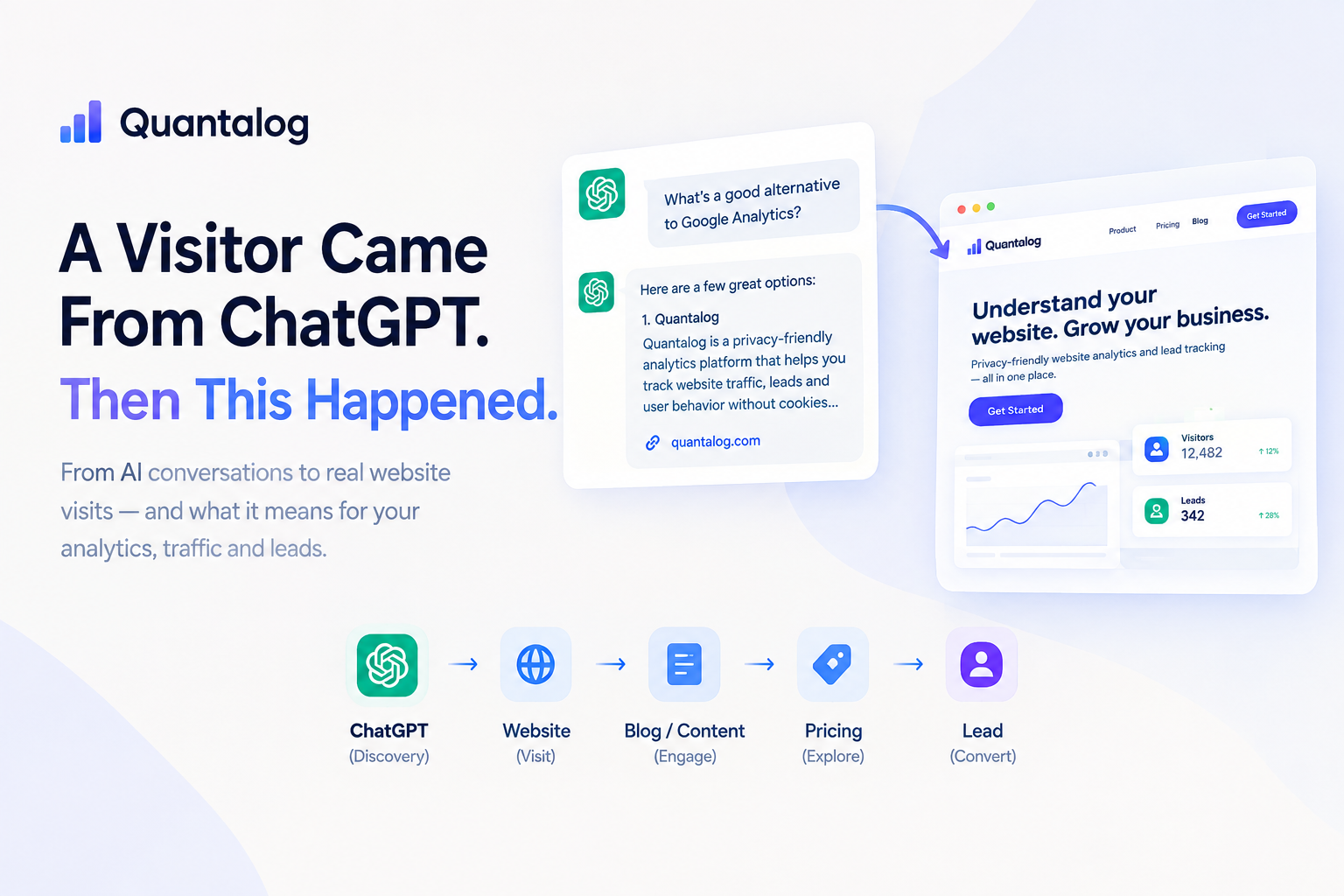
A few years ago, understanding where a website visitor came from was relatively straightforward. Someone searched on Google, clicked a social post, followed an email link, or typed your URL directly into the browser.
That model is changing.
Today, someone can ask ChatGPT a question, receive a recommendation, click a link, and arrive on your website without ever performing a traditional Google search.
For website owners, this creates an interesting new source of traffic—and a new analytics question:
What happens after someone discovers your website through AI?
From an AI conversation to a website visit
Consider a simple scenario.
Someone is looking for a privacy-focused analytics solution for their website. Instead of searching Google and opening several results, they ask ChatGPT for recommendations.
The conversation gives them a few options. They read through the explanation, decide that one of the products looks relevant, and click through to its website.
From the website's perspective, that person is now a normal visitor.
They might read an article, explore the product, open the pricing page, or submit a form.
The interesting part is that the first step in this journey happened outside the website.
The journey might look like this:
AI conversation → Website → Content → Product → Conversion
Traditional analytics already gives us tools for understanding what happens after the visitor arrives. The challenge is understanding the first part of the journey as AI becomes another discovery channel.
AI traffic is different from traditional search traffic
Search engines and AI assistants can both introduce people to your website, but the discovery experience is different.
A search engine generally presents a collection of results and lets the user decide which one to open. An AI assistant can instead summarize information, compare options, and recommend resources within a conversation.
That changes the context in which a visitor may arrive.
Someone clicking from a traditional search result may still be exploring a broad topic.
Someone clicking from an AI recommendation may have already spent several minutes describing their problem and narrowing down possible solutions.
That doesn't automatically make AI traffic more valuable. It simply means that the context behind the visit can be different.
And that's something worth measuring.
The attribution problem
There is another complication.
Not every visit influenced by an AI assistant will necessarily appear in analytics as a clean "ChatGPT" referral.
Referral information can vary depending on how a link is opened and how the visit reaches your website. Some traffic may be identifiable through referral information or campaign parameters, while other visits may eventually appear under broader categories such as direct traffic.
This makes AI attribution an imperfect measurement problem.
For example, imagine a website receives:
1,500 visitors from Google
200 from LinkedIn
80 from Reddit
40 directly from ChatGPT
600 classified as direct traffic
The 40 ChatGPT referrals are easy to understand.
The 600 direct visits are not.
Some may genuinely be people who typed the address into their browser. Others may have discovered the brand elsewhere and returned later. And some AI-influenced journeys may not be visible as a direct referral at all.
That is why AI traffic should be treated as one signal within a larger attribution picture, rather than as a perfectly measurable source of every AI-influenced visit.
The visit is only the beginning
Knowing that someone came from ChatGPT is useful, but it is not the most important piece of information.
The more useful question is what happened next.
Suppose an AI-referred visitor lands on a blog article and then follows this path:
Blog article → Product page → Pricing → Lead form
That tells you considerably more than simply knowing that ChatGPT generated a visit.
You can start asking better questions:
Which pages are attracting AI-referred visitors?
Are visitors exploring more than one page?
Which content leads them toward the product?
Are they reaching pricing pages?
Are they submitting forms?
Do they return later?
How does their behavior compare with visitors from other sources?
This is where traffic analytics becomes more than a collection of numbers.
It becomes a way to understand how people discover and interact with a business.
Content may become part of the AI discovery layer
There is another reason this matters for publishers and businesses.
Your website content is no longer written only for people who discover it through a search results page.
It can also become information that an AI system encounters, evaluates, summarizes, and potentially references when answering a user's question.
That makes useful, specific content increasingly important.
A generic article targeting a broad keyword may not provide much value.
A detailed article that clearly explains a real problem, provides useful information, and demonstrates first-hand expertise has a different purpose.
For example, instead of publishing another article titled:
"What Is Website Analytics?"
a company might publish:
"Why Is My Website Traffic Increasing but My Leads Aren't?"
The second topic addresses an actual problem.
And when someone asks an AI assistant about that problem, useful content has an opportunity to become part of the discovery process.
Measuring AI traffic without losing the bigger picture
It can be tempting to create a dashboard that focuses entirely on AI referrals.
But AI traffic should not be viewed in isolation.
A useful analytics setup should let you compare different acquisition sources and understand what each one contributes.
For example:
Traffic source | Visitors | Engaged sessions | Leads |
|---|---|---|---|
1,500 | 920 | 48 | |
280 | 190 | 17 | |
120 | 76 | 8 | |
AI referrals | 95 | 61 | 11 |
The exact numbers aren't important here.
What matters is the relationship between traffic, engagement, and outcomes.
A source that produces fewer visitors can still deserve attention if those visitors consistently perform meaningful actions.
Conversely, a source that produces thousands of visits may not contribute much to the business.
This is why looking at traffic volume alone can be misleading.
What should website owners watch?
If AI is becoming part of your acquisition strategy, there are a few signals worth monitoring.
Referral sources
Identify visits that can be attributed to AI platforms and other external sources.
Landing pages
Find out which pages visitors reach first.
This can reveal which pieces of content are attracting attention.
User journeys
Look beyond the landing page and understand what visitors do afterward.
Conversions
Connect traffic sources with meaningful actions such as form submissions, signups, or purchases.
Trends over time
A single AI referral is interesting.
A consistent increase in AI-driven visitors over several months is much more useful as a business signal.
The bigger shift
The important change isn't simply that ChatGPT can send traffic to websites.
The bigger change is how people discover information.
The traditional journey was often:
Search → Results → Website
The emerging journey can look more like:
Question → AI answer → Recommendation → Website
There are many variations in between, and not every AI interaction ends with a click.
But for businesses that depend on their websites for traffic, leads, or sales, understanding this new discovery layer is becoming increasingly relevant.
What this means for analytics
Analytics has always been about answering questions.
Where are visitors coming from?
What are they interested in?
Which pages are performing?
Which campaigns generate results?
AI adds another question:
Are people discovering our business through conversations with AI?
And once they arrive:
What do they do next?
That's the part worth paying attention to.
Quantalog helps bring these signals together by giving businesses visibility into website traffic, acquisition sources, visitor behavior, UTM campaigns, and lead activity in one place.
The goal isn't to chase every new traffic source.
It's to understand the journey behind the numbers.
Because a visitor from ChatGPT isn't particularly interesting just because they came from ChatGPT.
What's interesting is what happened after they arrived.
Try Quantalog on your own site
One script tag, no cookies, live numbers in about three seconds. Free forever on the Hobby plan.
Start freeKeep reading
Why Did This Visitor Leave After 3 Seconds?
A visitor lands on your website and leaves within seconds. Learn what a short session can tell you, what it cannot, and how to investigate the real cause.
Your Website Got 10,000 Visitors. So Why Did Nobody Buy?
Getting thousands of website visitors but no customers? Learn why traffic doesn't always lead to sales and how to identify where visitors drop off.