The Internet Is Getting More AI Traffic Than Ever — Can Analytics Still Tell Humans and Bots Apart?
AI crawlers, bots, and autonomous agents are changing website traffic. Learn how AI traffic affects analytics and how to distinguish humans, bots, and AI agents.

Quantalog
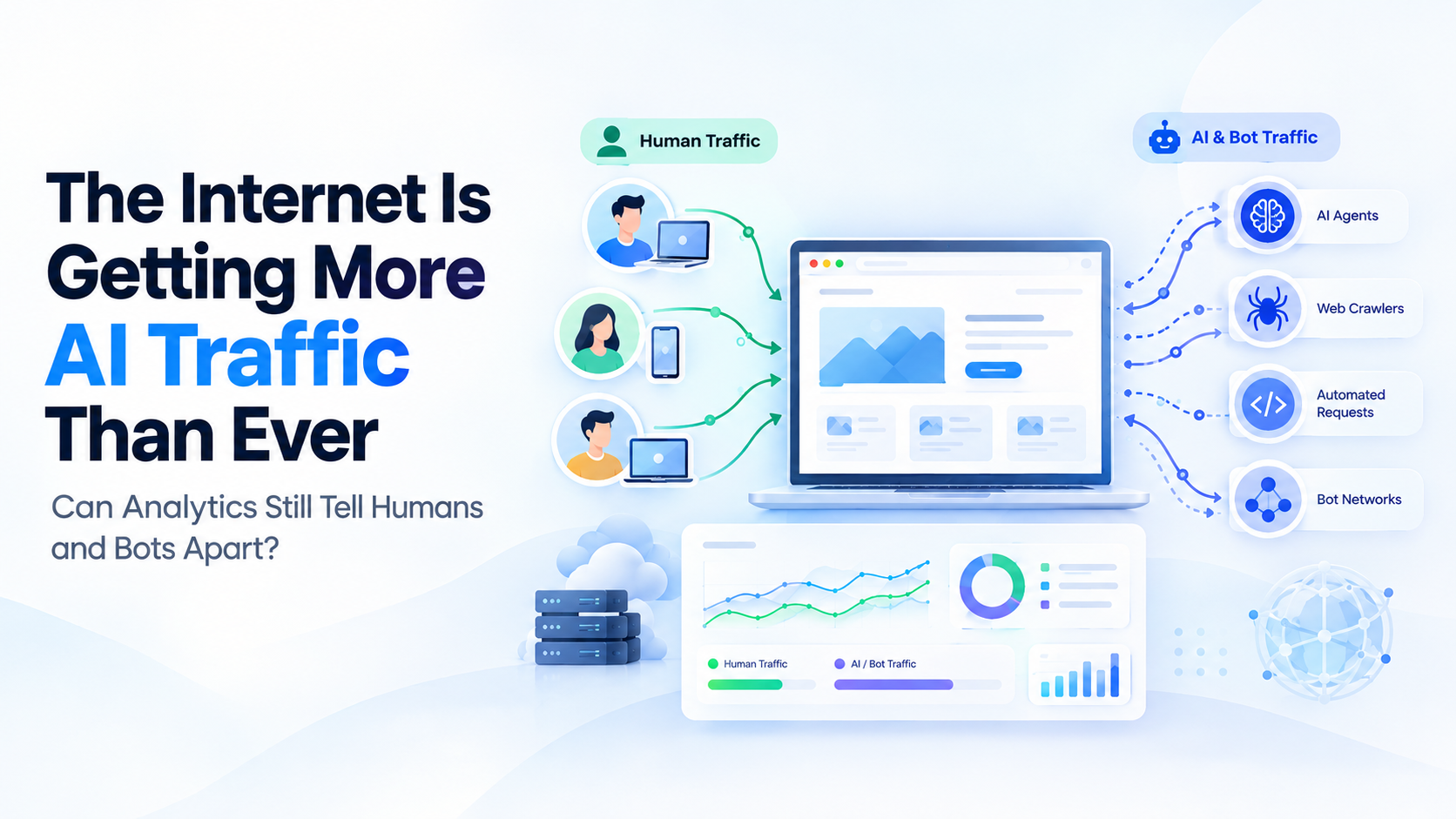
The Internet Is Getting More AI Traffic Than Ever
For decades, website analytics operated on a relatively simple assumption:
A visitor is probably a person.
That assumption was never completely true.
Search engines crawled websites. Monitoring tools requested pages. SEO bots analyzed content. Security scanners checked vulnerabilities. Price comparison engines collected product information.
But the modern web is introducing a much more complicated type of automated traffic.
AI systems are no longer only crawling websites. They are increasingly browsing, searching, reading, comparing, extracting information, and sometimes acting on behalf of users.
That creates a new problem for website owners:
When your analytics dashboard says you received 10,000 visitors, how many were actually humans?
And an even more important question:
Can traditional analytics reliably tell the difference?
The answer is becoming increasingly complicated.
AI Traffic Is No Longer Just “Bot Traffic”
The term bot traffic used to be relatively easy to understand.
A bot might be:
Googlebot
Bingbot
an SEO crawler
a monitoring service
a vulnerability scanner
a scraping script
an automated spam tool
But AI has introduced several new categories.
Today, a website may receive requests from:
Traffic Type | Typical Purpose | Human Behind It? |
|---|---|---|
Human visitor | Reading, shopping, browsing | Yes |
Search crawler | Indexing pages | No |
AI training crawler | Collecting content/data | No |
AI search crawler | Finding information for AI search | No |
AI agent | Performing a task for a user | Indirectly |
Browser automation | Completing automated actions | Sometimes |
Security bot | Scanning/protection | No |
Scraper | Extracting information | Usually no |
This distinction matters because not all automated traffic has the same business value.
A Google crawler visiting your pricing page is very different from an AI agent visiting your pricing page because a user asked an AI system to compare SaaS products.
And both are different from a malicious scraper repeatedly downloading your entire website.
AI Agent Traffic Is Growing
The growth isn't theoretical.
HUMAN's August 2026 State of Agentic Traffic report found that agentic traffic increased 27% during August and reached a new high. The report also found that approximately 80% of observed agentic activity involved product and search routes, including browsing listings, reading articles, and executing queries.
That tells us something important:
AI agents are increasingly behaving like web users — but they aren't humans.
Imagine someone asks an AI agent:
“Find me the best analytics tools for my SaaS website.”
The agent might:
Search the web.
Open multiple websites.
Read pricing pages.
Inspect feature pages.
Compare documentation.
Visit product pages.
Return a recommendation to the user.
From the website's perspective, however, those actions can look very different from a traditional human session.
The New Web Traffic Equation
The old mental model looked something like this:
                 WEBSITE
                    │
          ┌─────────┴─────────┐
          │                   │
       Humans               Bots
          │                   │
     Customers          Crawlers/SEO
The modern web is closer to this:
                         WEBSITE
                            │
       ┌────────────────────┼────────────────────┐
       │                    │                    │
    HUMANS              SEARCH BOTS          AI SYSTEMS
       │                    │                    │
       │              ┌─────┴─────┐        ┌─────┴─────┐
       │              │           │        │           │
    Visitors       Googlebot   Bingbot   AI Search   AI Agents
       │                                      │           │
   Customers                            Research     Actions
And there is another layer:
AI SYSTEMS
    │
    ├── Search crawlers
    ├── Training crawlers
    ├── Answer engines
    ├── Browser agents
    ├── Shopping agents
    ├── Coding agents
    └── Task automation agents
This makes a simple Human vs Bot classification increasingly insufficient.
How Much of the Web Is Actually Automated?
There isn't one universal number because different services measure different types of traffic and use different definitions.
Cloudflare reported in July 2026 that automated agents and bots accounted for more than half of all web requests in the traffic it observed. Cloudflare also introduced more granular classifications for AI traffic, including Search, Training, and Agent activity.
Meanwhile, Cloudflare's public AI Insights separates AI crawler activity from broader bot traffic and tracks things such as crawl purpose, HTTP requests, content type, and individual AI bot activity.
This distinction is important.
“Bot traffic” ≠ “AI traffic”
A website can have:
Total Traffic
│
├── Human
│
├── Traditional Bots
│   ├── Search engines
│   ├── SEO crawlers
│   ├── Monitoring
│   └── Security scanners
│
└── AI-related Traffic
    ├── AI Search
    ├── AI Training
    ├── AI Agents
    └── AI Browsers
So when someone says:
“40% of website traffic is bots”
that doesn't automatically mean:
“40% of website traffic is AI.”
The definitions and measurement methods matter.
Why Traditional Analytics Can Get Confused
Most website analytics systems were originally designed around concepts like:
users
sessions
pageviews
events
referrals
devices
browsers
countries
These metrics were primarily designed to understand people interacting with websites.
But automated systems can generate similar requests.
Consider this example.
Human session
User opens homepage
        ↓
Reads article
        ↓
Visits pricing
        ↓
Clicks signup
        ↓
Leaves
Analytics might record:
1 user
1 session
3 pageviews
1 conversion event
Now consider an AI agent.
AI agent opens homepage
        ↓
Reads documentation
        ↓
Visits pricing
        ↓
Checks API docs
        ↓
Reads FAQ
        ↓
Leaves
Depending on how the site is accessed, analytics may see something that resembles a highly engaged visitor.
But there was no human sitting there clicking through the website.
The “Fake Engagement” Problem
This creates an interesting analytics problem.
Imagine your website normally receives:
10,000 sessions
Your analytics reports:
Average session duration: 3m 12s
Pages/session: 3.4
Bounce rate: 42%
Looks healthy.
But then an AI crawler starts systematically reading your content.
It visits:
/home
/docs
/pricing
/blog
/features
/api
Suddenly:
Pages/session ↑
Session duration ↑
Pageviews ↑
Traffic ↑
Your dashboard may interpret this as:
“Visitors are more engaged.”
But the reality could be:
“Automated systems are consuming more of the website.”
That's a completely different business interpretation.
Why “User” Is Becoming a Complicated Metric
Historically:
User = Person
Increasingly:
User
│
├── Human
│
├── Human + AI assistance
│
├── AI browsing on behalf of human
│
├── Autonomous AI agent
│
└── Automated bot
This doesn't mean analytics is becoming useless.
It means the definition of traffic quality is changing.
A website owner may now need to ask:
Who generated this request?
rather than simply:
How many requests did I receive?
Can Analytics Actually Tell Humans and Bots Apart?
Yes — but not perfectly.
Modern bot detection can combine multiple signals rather than relying on a single user-agent string.
A useful detection model looks something like:
                 REQUEST
                    │
        ┌───────────┼───────────┐
        ↓           ↓           ↓
   User Agent    Behavior     Network
        │           │           │
        └───────────┼───────────┘
                    ↓
             Classification
                    │
       ┌────────────┼────────────┐
       ↓            ↓            ↓
     HUMAN       AI/BOT       UNKNOWN
Possible signals include:
1. User-Agent
The browser or client may identify itself.
Examples can include:
Mozilla/5.0 ...
Googlebot/2.1
GPTBot
ClaudeBot
But user-agent detection alone isn't enough.
It can be spoofed.
2. IP and network information
Analytics/security systems can analyze:
IP reputation
autonomous system
data-center ranges
geographic patterns
request frequency
A request coming from a known cloud infrastructure provider doesn't automatically mean it's a bot, but it can be an additional signal.
3. Request behavior
This can be much more useful.
For example:
Human:
Homepage
   ↓
Blog
   ↓
Pricing
   ↓
Contact

AI crawler:
Homepage
   ↓
/docs
   ↓
/api
   ↓
/pricing
   ↓
/faq
   ↓
/blog
   ↓
/sitemap
The sequence itself can provide useful information.
4. Request frequency
A human might request a handful of pages over several minutes.
An automated crawler might request hundreds or thousands of URLs rapidly.
For example:
Human:
12 requests / 5 minutes

Crawler:
850 requests / 5 minutes
This isn't definitive, but it is a strong behavioral signal.
5. JavaScript execution
Many traditional analytics systems rely on JavaScript running inside a browser.
Some bots don't execute JavaScript in the same way a normal browser does.
However, modern AI agents and browser automation tools can operate real browsers, so this signal is also becoming less reliable by itself.
The Hardest Category: AI Agents
Traditional bots are relatively easy to conceptualize.
AI agents are different.
An AI agent can potentially:
Think
 ↓
Search
 ↓
Open website
 ↓
Read content
 ↓
Click
 ↓
Fill form
 ↓
Compare information
 ↓
Take action
That means an AI agent can look much more like a human browser session.
Cloudflare now explicitly distinguishes Agent activity from other AI crawler purposes. Its definition covers automated activity acting in real time on a person's behalf, including chat-fetch bots and browser-use agents.
This is one of the biggest changes coming to web analytics.
AI Traffic Isn't Necessarily Bad
It's important not to treat every AI request as unwanted traffic.
There are different reasons an AI system might access your website.
AI Activity | Potential Value |
|---|---|
AI search indexing | Increased discoverability |
AI answer generation | Your content may be cited |
Product research | Potential customer discovery |
Shopping comparison | Potential purchase intent |
Documentation retrieval | Developer discovery |
AI training | Depends on publisher's goals |
Scraping | May have little direct value |
Malicious automation | Potentially harmful |
The key issue is visibility.
Website owners need to know which type of automated traffic they're receiving.
The Difference Between Crawling and Referral Traffic
Here's another important distinction.
Suppose an AI system visits your website 50,000 times.
That sounds impressive.
But what happens afterward?
AI crawler
    ↓
Reads content
    ↓
Answers user
    ↓
User never visits your website
From a traditional analytics perspective:
AI activity = 50,000 requests
Human referrals = 0
That's very different from:
AI activity = 50,000 requests
Human referrals = 5,000
This is why simply measuring AI crawler volume isn't enough.
You need to understand:
AI traffic → content consumption → referral → human visit → conversion
Cloudflare has even introduced analytics around AI consumption and crawl-to-referral relationships, reflecting this growing need to understand whether automated consumption results in human traffic.
A New Analytics Funnel
Traditional web analytics often looks like:
Impression
    ↓
Visit
    ↓
Session
    ↓
Pageview
    ↓
Conversion
The AI-powered web may require something closer to:
AI Discovery
      ↓
AI Crawl
      ↓
AI Answer / Recommendation
      ↓
Human Click
      ↓
Website Visit
      ↓
Engagement
      ↓
Conversion
This is a major shift.
The website visit may no longer be the first interaction between your brand and the user.
The first interaction could happen inside an AI system.
What Should Modern Website Analytics Track?
A modern analytics platform should consider separating traffic into multiple dimensions.
Traffic identity
Human
Known Bot
AI Crawler
AI Agent
Unknown Automation
Unknown
AI purpose
Search
Training
Agent
Unknown
Source
Google
OpenAI
Anthropic
Meta
Microsoft
Amazon
Other
Behavior
Requests
Pages accessed
Request frequency
Session duration
Navigation pattern
Content accessed
Business impact
AI referral
Human referral
Signup
Purchase
Lead
Conversion
This produces a much more useful picture than simply:
Visitors: 25,432
Example: Two Websites, Same Traffic
Consider two websites.
Website A
100,000 requests

Human:       80,000
Bots:        15,000
AI traffic:   5,000
Website B
100,000 requests

Human:       35,000
Bots:        25,000
AI traffic:  40,000
Traditional analytics might say:
Both websites received 100,000 requests.
But the traffic composition is completely different.
For Website B, a large percentage of activity isn't coming from humans.
Without traffic classification, the owner could make incorrect conclusions about:
audience growth
engagement
content popularity
server usage
marketing performance
conversion rates
Why Pageviews Alone Aren't Enough Anymore
Pageviews are still useful.
But a pageview doesn't answer:
Who viewed the page?
It only tells you:
A request/page interaction occurred.
Consider:
100,000 pageviews
This could mean:
Scenario A
90,000 human
10,000 bots
or:
Scenario B
40,000 human
20,000 traditional bots
40,000 AI systems
Same pageview number.
Completely different story.
AI Traffic Can Also Affect Infrastructure
AI crawlers and agents don't only affect analytics.
They can affect:
server load
bandwidth
API usage
database queries
CDN costs
rate limits
caching
application performance
Imagine an AI agent repeatedly requesting a documentation endpoint:
/api/docs
/api/docs
/api/docs
/api/docs
...
If your analytics only records the traffic after the application processes it, you might discover the problem too late.
That's why analytics and observability increasingly overlap.
You need to understand both:
Who is visiting?
and:
What is that traffic doing to my system?
The Analytics Stack Is Changing
A modern website can benefit from multiple layers.
                WEB TRAFFIC
                     │
        ┌────────────┼────────────┐
        ↓            ↓            ↓
     CDN/WAF       Server       Analytics
        │            │            │
        ↓            ↓            ↓
   Bot signals    Requests     Sessions
        │            │            │
        └────────────┼────────────┘
                     ↓
             Traffic Intelligence
                     │
       ┌─────────────┼─────────────┐
       ↓             ↓             ↓
    Humans        AI/Bots        Unknown
       │             │             │
       └─────────────┼─────────────┘
                     ↓
              Business Insights
This is where analytics platforms can evolve beyond simply counting visitors.
How Website Owners Can Start Today
You don't necessarily need an extremely complicated AI detection system.
Start by tracking the fundamentals.
1. Separate known bots
Maintain a classification for recognized crawlers and automated systems.
isBot = true
botType = "search"
2. Add AI-specific categories
Instead of:
bot = true
consider:
trafficType = "ai"
aiPurpose = "search"
or:
trafficType = "ai"
aiPurpose = "agent"
3. Track unknown automation
Not every automated request will identify itself clearly.
Use:
human
known_bot
ai_bot
unknown_automation
unknown
This prevents your analytics from pretending that every request can be classified with certainty.
4. Compare AI activity with human referrals
This is one of the most valuable measurements.
For example:
AI crawler requests:        42,000
AI-origin referrals:        1,850
Human sessions:             25,400
Conversions from AI:          210
Now the business can ask meaningful questions.
A Better Analytics Dashboard for the AI Era
Imagine your dashboard showing:
┌───────────────────────────────────────────────┐
│ TRAFFIC OVERVIEW                              │
├───────────────────────────────────────────────┤
│                                               │
│ Total Requests              152,430           │
│ Human Traffic                71,240           │
│ AI Traffic                   38,210           │
│ Traditional Bots             34,980           │
│ Unknown Automation            7,990           │
│                                               │
├───────────────────────────────────────────────┤
│ AI TRAFFIC                                    │
│                                               │
│ Search             21,400                     │
│ Agent              10,820                     │
│ Training            5,990                     │
│ Unknown               0                       │
│                                               │
├───────────────────────────────────────────────┤
│ AI → HUMAN REFERRALS                          │
│                                               │
│ AI referrals       2,140                      │
│ Signups              184                      │
│ Conversions           72                      │
│                                               │
└───────────────────────────────────────────────┘
That tells a website owner far more than:
Visitors: 71,240
What Quantalog Can Mean in This New Era
The role of analytics is changing.
It's no longer enough to answer:
“How many people visited my website?”
Modern website owners increasingly need answers to questions such as:
“How much of my traffic was actually human?”
“Which AI systems are accessing my website?”
“Are AI crawlers consuming my content?”
“Are AI systems sending real visitors back to my website?”
“Which pages are being accessed most by automated systems?”
“Did my traffic increase because of people — or because of automation?”
This creates a natural evolution for privacy-focused analytics platforms like Quantalog.
Instead of treating every request as another anonymous visitor number, analytics can increasingly become a layer of traffic intelligence.
The Future: Human Analytics + AI Traffic Analytics
The next generation of web analytics probably won't eliminate the traditional metrics.
We'll still need:
visitors
sessions
pageviews
countries
devices
browsers
referrals
conversions
But these metrics can be enriched with another dimension:
WHO OR WHAT GENERATED THE ACTIVITY?
The future model could look like:
                    WEBSITE
                       │
              ┌────────┴────────┐
              │                 │
           HUMAN             MACHINE
              │                 │
       ┌──────┴──────┐    ┌─────┴─────────┐
       │             │    │               │
    Visitor       Customer  Search       AI Agent
                            │             │
                         Crawler      Task Execution
                            │             │
                         Indexing     Research
                            │             │
                         Discovery   Transaction
And eventually, the distinction may become even more nuanced.
Because the question won't simply be:
Human or bot?
It may become:
Human, AI-assisted human, AI agent, crawler, automated service, or unknown system?
The Biggest Analytics Challenge Ahead
The biggest challenge isn't detecting that bots exist.
We've known about bots for decades.
The challenge is understanding intent and value.
A request from an AI search crawler is different from an AI training crawler.
An AI research agent is different from a malicious scraper.
A browser agent acting for a customer is different from a traditional bot.
And a human using an AI browser can create a session that looks partially human and partially automated.
That's why the future of analytics isn't simply:
Human vs Bot
It is:
Traffic Identity
        +
Traffic Purpose
        +
Traffic Behavior
        +
Business Outcome
Final Takeaway
The web is becoming increasingly automated.
AI systems are no longer limited to generating answers inside chat interfaces. They are increasingly interacting with the web itself — searching, crawling, reading, comparing, and acting on behalf of users.
HUMAN's latest agentic-traffic data shows that this activity is already growing, while platforms such as Cloudflare are adding dedicated tools to distinguish AI Search, AI Training, and AI Agent traffic.
For website owners, this means one thing:
A traffic number without traffic identity is becoming less informative.
The next generation of analytics won't just count visitors.
It will help answer:
Who — or what — is actually interacting with your website?
And that may become one of the most important analytics questions of the AI-powered web.
Quick Checklist: Is Your Analytics Ready for AI Traffic?
Use this checklist to evaluate your current setup:
Can you identify known bots?
Can you separate AI traffic from traditional bot traffic?
Can you identify AI search crawlers?
Can you identify AI agents?
Can you distinguish automated requests from human sessions?
Can you monitor unusual request patterns?
Can you see which pages AI systems access?
Can you measure AI-generated referrals?
Can you connect AI referrals to conversions?
Can you distinguish traffic volume from actual human engagement?
If most of these answers are no, your analytics may be measuring traffic volume without fully explaining the traffic behind it.
Frequently Asked Questions
1. What is AI traffic?
AI traffic refers to requests and interactions generated by AI systems, including AI crawlers, AI search systems, training crawlers, browser agents, and autonomous agents.
2. Is AI traffic the same as bot traffic?
No. AI traffic is a subset or category of automated traffic, depending on the measurement system. Traditional bots can include search crawlers, monitoring systems, security scanners, and other automation.
3. Can Google Analytics detect AI bots?
Traditional analytics can identify some automated traffic, but no single client-side analytics signal can perfectly identify every AI system. Modern detection generally benefits from combining user-agent, behavioral, network, and server-side signals.
4. Why does AI traffic matter to website owners?
AI traffic can affect website visibility, server resources, content consumption, analytics numbers, and potentially human referrals. Understanding its source and purpose helps website owners interpret their traffic more accurately.
5. Can an AI agent look like a human visitor?
Yes. Browser-based AI agents can perform actions that resemble normal browser activity, making simple bot detection less reliable.
6. Should websites block AI bots?
There is no universal answer. Different AI systems can have different purposes, and website owners may have different goals for search visibility, content discovery, training, security, and resource usage. Modern bot-management systems increasingly allow site owners to apply different policies based on AI traffic purpose.
7. What should modern analytics measure?
Modern analytics can combine traditional metrics such as visitors, sessions, pageviews, and conversions with traffic identity, bot classification, AI activity, referral information, and behavioral signals.
Start Measuring Traffic Differently
The web is changing.
More automated systems are discovering and interacting with websites every day.
That makes accurate traffic intelligence more important than ever.
Quantalog helps website owners understand what is happening across their websites with privacy-focused analytics and actionable traffic insights.
Don't just count traffic. Understand it.
Sources & further reading
HUMAN — State of Agentic Traffic: August 2026
Cloudflare — Analyze AI Traffic
Cloudflare — Bot Analytics
Cloudflare — Block AI Bots
Cloudflare — Building the Business Model for the Agentic Internet
Cloudflare — AI Traffic and Agentic Internet
Try Quantalog on your own site
One script tag, no cookies, live numbers in about three seconds. Free forever on the Hobby plan.
Start freeKeep reading
How AI Search Is Changing Website Traffic in 2026
AI search is changing how people discover websites, interact with search results, and decide when to click. Learn how AI Overviews, AI Mode, ChatGPT, Gemini, and other AI platforms are reshaping website traffic in 2026 and what website owners should measure now.
Quantalog Analytics: A Simpler, Privacy-First Way to Understand Your Website Traffic
Discover how Quantalog helps you track website visitors, traffic sources, conversions, SEO, and real-time analytics without cookies or complicated dashboards.