How to Track ChatGPT Traffic to Your Website in 2026
Learn how to identify, measure, and analyze traffic coming from ChatGPT to your website, including referral sources, pages, visitors, and conversions.

Quantalog
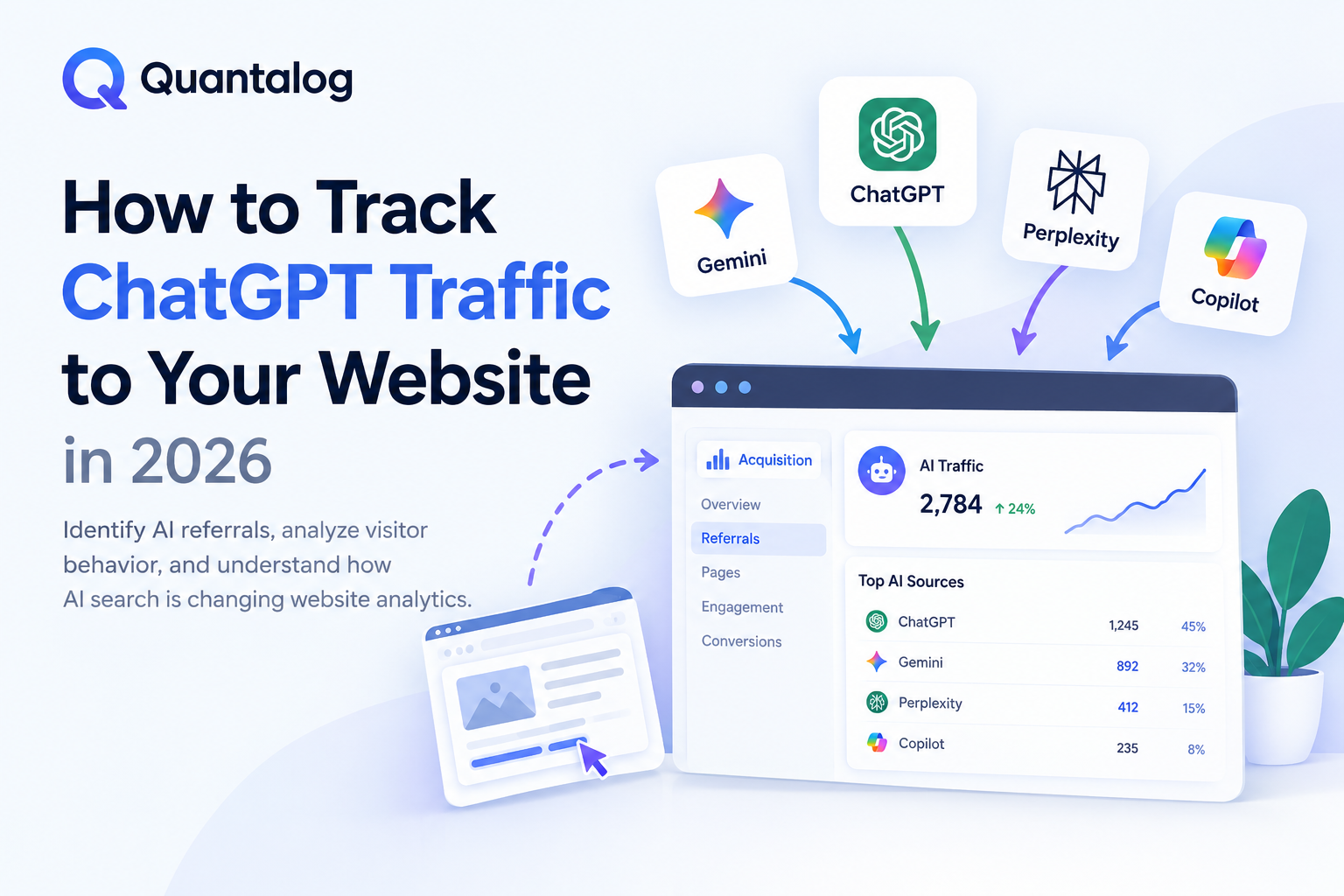
How to Track ChatGPT Traffic to Your Website in 2026
For years, website traffic was relatively easy to understand.
Someone searched for something on Google, clicked a result, and arrived at your website. You could look at your analytics dashboard and see organic search traffic, referral traffic, social traffic, direct visits, and paid campaigns.
That discovery journey is changing.
People are increasingly using AI platforms such as ChatGPT, Gemini, and Perplexity to discover websites, products, businesses, and information. Instead of searching through pages of results, they can ask an AI system a question and receive a curated answer with links to relevant sources.
This creates a new question for website owners:
How much of my website traffic is coming from AI platforms such as ChatGPT?
And more importantly:
What are those visitors doing after they arrive?
In this guide, we'll look at what ChatGPT referral traffic is, how you can identify it, which metrics matter, and how AI traffic can become part of your regular website analytics strategy.
What Is ChatGPT Traffic?
ChatGPT traffic refers to visitors who reach your website after interacting with ChatGPT.
For example, imagine someone asks:
"What are the best analytics tools for a small SaaS website?"
ChatGPT might mention several analytics platforms and provide links to their websites.
If the user clicks one of those links and lands on your website, that visit can become an AI-generated referral.
The journey looks something like this:
User question → ChatGPT response → Website recommendation → Click → Website visit
This is different from the traditional search journey:
Google search → Search results → Website → Website visit
The important difference is where the discovery happens.
Why AI Referral Traffic Matters
Website owners have traditionally focused on Google rankings, social media campaigns, email marketing, and paid advertising.
AI platforms introduce another potential discovery channel.
A user may never search directly for your brand but could still discover it through an AI-generated recommendation.
For example:
A developer asks for React tools.
A business owner asks for analytics software.
A marketer asks for SEO tools.
A customer asks for alternatives to a particular product.
A local customer asks for businesses that provide a particular service.
If your website is mentioned or linked in those conversations, AI can potentially become another path through which users discover your business.
That makes AI referral traffic worth monitoring.
How to Track ChatGPT Traffic
There isn't one universal method that guarantees every ChatGPT visit will be classified perfectly.
Attribution can depend on how the user accesses the link, the browser, redirects, tracking parameters, and the analytics implementation.
However, there are several practical ways to investigate AI traffic.
1. Check Your Referral Sources
Start with the referral data available in your analytics platform.
Look for traffic associated with AI platforms and AI-related domains.
Depending on the platform and visit path, you may see sources associated with services such as:
ChatGPT
Gemini
Perplexity
Microsoft Copilot
Other AI-powered search platforms
If you notice an AI platform appearing as a referral source, you can begin separating those visitors from your other referral traffic.
2. Create an AI Traffic Segment
Instead of looking at every referral individually, create a dedicated category for AI traffic.
For example:
AI Traffic
ChatGPT
Gemini
Perplexity
Copilot
Other AI sources
Now you can compare AI traffic with:
Organic Search | Direct | Social | Referral | AI
This makes your analytics much easier to understand.
3. Analyze AI Landing Pages
Knowing how many visitors came from ChatGPT is useful.
Knowing which pages they visited is even more useful.
Suppose your website receives 1,000 AI-referred visitors and 700 of them land on the same article.
That tells you something important about the content being discovered through AI.
Track metrics such as:
Landing page
Pageviews
Sessions
Engagement
Exit rate
Conversion rate
This can help you identify content that is attracting AI-driven visitors.
What Should You Measure?
AI traffic shouldn't be measured only by visitor count.
A better approach is to follow the complete journey.
Visitors
How many visitors came from AI platforms?
Sessions
How many sessions were generated?
Pageviews
How many pages did those visitors view?
Landing Pages
Which pages are attracting AI traffic?
Engagement
Do AI-referred visitors explore your website?
Conversions
Do they sign up, submit a form, purchase something, or perform another important action?
The real value is not simply:
"We received 500 AI visitors."
It is:
"We received 500 AI visitors, 180 engaged with our content, and 25 completed a conversion."
That gives you much more useful information.
ChatGPT Traffic vs Traditional Search Traffic
AI discovery and traditional search aren't necessarily competing channels.
They represent different ways users can find information.
Consider two users looking for an analytics platform.
Traditional Search
The user searches:
"Best website analytics tools"
They receive search results and choose a website.
AI Discovery
Another user asks:
"Which website analytics tool should I use for my small SaaS?"
The AI system provides recommendations and links.
Both users may eventually visit the same website.
But their discovery paths are different.
That is why analytics systems need to increasingly understand where discovery happens, not just where the final click comes from.
Why AI Traffic Can Be Difficult to Identify
One of the biggest challenges with AI traffic is attribution.
Not every AI-assisted visit will necessarily appear as a clean:
chatgpt.com → yourwebsite.com
referral.
Several things can affect attribution:
Browser behavior
Redirects
Link structure
Privacy settings
Tracking configuration
User navigation
Mobile applications
Copying and pasting URLs
Direct visits after AI discovery
For example, someone might discover your website through ChatGPT, remember the brand name, and later type the URL directly into their browser.
Analytics may then classify that visit as direct traffic.
So AI referral numbers should be treated as an observable measurement rather than a perfect representation of every visit influenced by AI.
Don't Focus Only on ChatGPT
ChatGPT is one of several AI discovery platforms.
If you're building an AI traffic dashboard, it makes sense to monitor multiple sources.
For example:
AI Platform | What to Monitor |
|---|---|
ChatGPT | Referrals, landing pages, visitors |
Gemini | Referrals, sessions, engagement |
Perplexity | Referrals, landing pages |
Copilot | Referrals and visitors |
Other AI tools | Emerging referral sources |
This gives you a broader view of AI-driven discovery.
AI Search Is Creating a New Analytics Layer
Traditional website analytics generally focuses on questions like:
Where did my visitor come from?
What page did they visit?
How long did they stay?
Did they convert?
AI introduces another layer:
Was my website discovered through an AI system?
This distinction is becoming increasingly relevant as people use AI systems for research and recommendations.
A website might rank well in Google but receive little AI traffic.
Another website might have modest traditional search visibility but frequently appear in AI-generated recommendations.
These are different forms of digital visibility.
How Website Owners Can Prepare
You don't need to completely replace your existing SEO strategy.
Instead, start treating AI discovery as an additional channel.
Step 1: Keep your existing analytics
Continue monitoring:
Organic traffic
Direct traffic
Referral traffic
Social traffic
Campaign traffic
Step 2: Monitor AI referrals
Look for identifiable traffic from AI platforms.
Step 3: Track important pages
Identify which content attracts AI-referred visitors.
Step 4: Measure conversions
Don't stop at traffic numbers.
Track whether those visitors perform meaningful actions.
Step 5: Compare channels
Compare AI traffic with your other acquisition channels.
Over time, this can show whether AI is becoming a meaningful source of visitors for your website.
Can You Track ChatGPT Traffic With Google Analytics?
Yes, Google Analytics can help you analyze referral and acquisition data, but attribution isn't always perfect.
Depending on how the visitor reaches your website, an AI-originated visit may appear differently in your reports.
This is why website owners should avoid relying on a single metric.
Instead, combine:
Referral data + landing pages + campaign parameters + behavioral analytics
to get a better understanding of AI-driven traffic.
Can You Track ChatGPT Traffic Without Cookies?
Yes, it is possible to build analytics systems that don't rely on traditional third-party cookies.
A privacy-focused analytics implementation can focus on useful aggregated information such as:
Pageviews
Sessions
Referral sources
Landing pages
Device categories
Countries
Campaign parameters
However, the exact implementation and legal requirements depend on your product, jurisdiction, and privacy approach.
The goal should be to collect the information you actually need while minimizing unnecessary personal data.
Using Quantalog to Monitor Website Traffic
Quantalog helps website owners understand what's happening on their websites through a single analytics dashboard.
Instead of looking only at total visitors, you can analyze metrics such as:
Visitors
Sessions
Pageviews
Bounce rate
Countries
Devices
Referral sources
UTM campaigns
This makes it easier to investigate traffic sources and identify new acquisition channels, including traffic originating from AI platforms.
For businesses investing in AI search visibility, combining AI discovery with website analytics can provide a more complete picture of the customer journey.
The Future of Website Analytics Is Bigger Than Search
Search isn't disappearing.
Google, Bing, social media, communities, email, and direct traffic will continue to matter.
But AI is adding another layer to the discovery process.
Instead of:
Search → Result → Website
we increasingly have:
Question → AI Answer → Recommendation → Website
For website owners, that means understanding traffic sources will become more important than ever.
The question is no longer only:
"How well does my website rank?"
It is also:
"How are people discovering my website?"
And AI platforms are becoming part of that conversation.
Final Thoughts
ChatGPT and other AI platforms are changing how people discover information online.
For website owners, this creates a new opportunity to understand AI-driven discovery and measure what happens after those visitors reach their websites.
Start by monitoring referral sources, identifying AI-related traffic, analyzing landing pages, and measuring engagement and conversions.
Don't treat AI traffic as a replacement for SEO or other acquisition channels.
Instead, treat it as another source of discovery that you can measure, compare, and learn from.
The websites that understand their traffic sources today will be in a much better position to understand how digital discovery evolves tomorrow.
Frequently Asked Questions
How do I track ChatGPT traffic?
Use your website analytics platform to inspect referral and acquisition sources and look for identifiable traffic from ChatGPT. Keep in mind that not every AI-influenced visit will necessarily be attributed as a ChatGPT referral.
Is ChatGPT traffic considered referral traffic?
When a visitor arrives through a detectable link from ChatGPT, analytics may classify it as referral traffic. However, attribution can vary depending on how the visitor reached your website.
Can Google Analytics track ChatGPT traffic?
Google Analytics can provide referral and acquisition information that may help identify ChatGPT traffic, although attribution isn't guaranteed for every AI-influenced visit.
What other AI traffic should I track?
Consider monitoring traffic associated with platforms such as ChatGPT, Gemini, Perplexity, and Microsoft Copilot, along with other AI discovery sources that become relevant to your audience.
Why is AI referral traffic important?
It can help website owners understand whether AI platforms are becoming a meaningful discovery channel and which pages or content are attracting visitors from those platforms.
Try Quantalog on your own site
One script tag, no cookies, live numbers in about three seconds. Free forever on the Hobby plan.
Start freeKeep reading
The Internet Is Getting More AI Traffic Than Ever — Can Analytics Still Tell Humans and Bots Apart?
AI crawlers, bots, and autonomous agents are changing website traffic. Learn how AI traffic affects analytics and how to distinguish humans, bots, and AI agents.
How AI Search Is Changing Website Traffic in 2026
AI search is changing how people discover websites, interact with search results, and decide when to click. Learn how AI Overviews, AI Mode, ChatGPT, Gemini, and other AI platforms are reshaping website traffic in 2026 and what website owners should measure now.