GEO vs SEO: What’s the Difference and Which One Does Your Website Need in 2026?

Quantalog
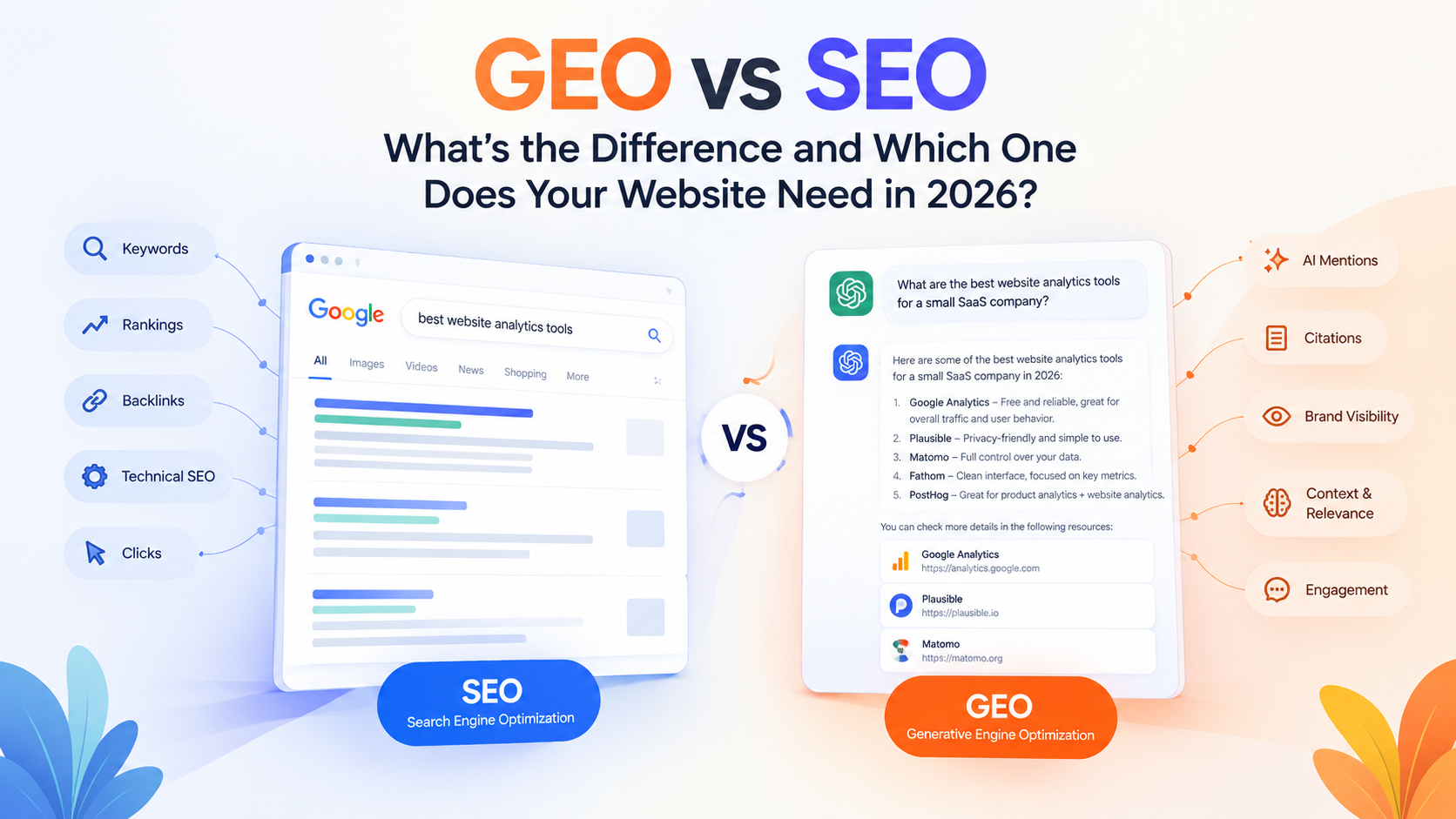
For years, SEO was the foundation of website visibility.
If you wanted people to discover your business online, you optimized your website for search engines, created useful content, earned backlinks, improved technical performance, and worked toward higher rankings on Google and other search engines.
But search is changing.
People are increasingly using AI-powered search experiences to find information, compare products, research businesses, and answer questions.
Instead of typing a keyword into Google and opening several websites, a user might now ask an AI system:
"What are the best analytics tools for a small SaaS company?"
The AI can provide a direct answer, summarize information, recommend products, and sometimes provide links to supporting sources.
This has created a new term that marketers are hearing everywhere:
GEO — Generative Engine Optimization.
But does GEO replace SEO?
Not exactly.
In 2026, the relationship between SEO and GEO is better understood as an overlap rather than two completely separate strategies. Google itself says its existing SEO best practices continue to matter for its generative AI search features.
So what exactly is the difference?
Let's break it down.
What Is SEO?
SEO stands for Search Engine Optimization.
It is the process of improving a website so that search engines can understand its content and potentially show it prominently for relevant searches.
Traditional SEO focuses on search engines such as Google and Bing.
For example, imagine you run a website selling analytics software.
You might create a page targeting:
"Best website analytics tools for SaaS"
Your SEO strategy could include:
Creating useful content
Optimizing page titles
Writing descriptive meta descriptions
Improving website structure
Building internal links
Improving page speed
Making the website mobile-friendly
Earning relevant backlinks
Using structured data where appropriate
Creating original and helpful information
The basic journey looks like this:
User searches → Search engine shows results → User clicks → Website
The goal is generally to increase qualified visibility and visits from search.
What Is GEO?
GEO stands for Generative Engine Optimization.
The term generally refers to efforts to increase the likelihood that your brand, website, products, or information are mentioned, represented, or cited in AI-generated answers.
Instead of optimizing only for a traditional list of search results, you're also thinking about how your content can be discovered and used by AI-powered search experiences.
For example, a user might ask:
"What are some alternatives to Google Analytics for a privacy-focused website?"
An AI search system could mention several products.
If your product is included in that answer, you've gained AI visibility.
The journey can look like:
User asks AI → AI generates answer → Brand/content is mentioned → User may visit website
The important difference is that the user can receive useful information without necessarily clicking a website.
SEO vs GEO: The Basic Difference
The easiest way to understand the difference is to look at the desired outcome.
SEO | GEO |
|---|---|
Search Engine Optimization | Generative Engine Optimization |
Focuses on traditional search visibility | Focuses on visibility within AI-generated answers |
Primarily targets search engines | Targets AI-powered search and answer experiences |
Rankings are an important measurement | Mentions, citations, and AI visibility can matter |
Clicks are a major outcome | Visibility can occur even without a click |
Keywords are commonly important | Topics, entities, context, and useful information matter |
Backlinks can support authority | Third-party mentions and corroborating information can help |
Search results are the primary surface | AI answers are an additional discovery surface |
However, this doesn't mean SEO and GEO are completely separate disciplines.
In practice, there is considerable overlap.
Does GEO Replace SEO?
No.
For most websites, the practical approach is to continue investing in SEO while adapting content and measurement for AI search.
Google's own 2026 documentation specifically says that SEO best practices remain relevant for appearing in its generative AI features.
This makes sense because AI search systems often rely on web content to discover, understand, verify, and contextualize information.
So rather than thinking:
SEO OR GEO
think:
SEO + AI Search Visibility
Your SEO foundation still matters.
But the way users discover and interact with information is expanding.
Why Is GEO Suddenly So Popular?
AI search has created a new discovery surface.
Current industry research shows rapidly increasing search interest around terms such as:
Generative Engine Optimization
AI visibility
AI search optimization
AI Overview optimization
GEO vs SEO
Ahrefs reported that search interest for "generative engine optimization" increased dramatically over the previous 18 months, while searches for "GEO vs SEO" also saw substantial growth.
This isn't surprising.
Marketers are noticing that people can now discover brands without following the traditional:
Google → Search result → Click
journey.
How AI Search Changes the Customer Journey
Traditional search often looks like this:
Step 1
A user searches for a question.
Step 2
The search engine displays results.
Step 3
The user compares several results.
Step 4
The user clicks a website.
Step 5
The user reads the content.
AI search can shorten this journey.
Step 1
The user asks a detailed question.
Step 2
The AI system generates a response.
Step 3
The AI summarizes information from available sources.
Step 4
The user may click a citation or recommendation.
Step 5
Or the user may leave without visiting any website.
This creates what marketers often call a zero-click experience.
The user gets the answer without necessarily visiting the source.
Why Zero-Click Searches Matter
This creates an important change in how website owners think about visibility.
Historically, one of the main goals of SEO was:
Get the user to click my result.
With AI search, another question becomes important:
Is my brand or information being represented in the answer at all?
A website could potentially receive fewer direct clicks while still gaining visibility through AI-generated answers.
That doesn't make clicks unimportant.
It simply means that clicks are no longer the only possible outcome of search visibility.
What Does GEO Actually Optimize?
There is no single official checklist that guarantees inclusion in AI answers.
AI systems differ in how they retrieve information, select sources, generate answers, and update their underlying systems.
However, several principles are useful.
1. Create Original Information
Generic content is easy to reproduce.
Original research, first-hand experience, unique datasets, case studies, experiments, and specific insights give your website something more valuable to reference.
For example, instead of writing:
"Website traffic is important for businesses."
you could publish:
"We analyzed 100 SaaS websites and found that..."
Original information provides a stronger reason for other websites and AI systems to reference your work.
2. Answer Specific Questions
AI systems are designed to answer questions.
That makes question-focused content useful.
Instead of creating a vague article called:
"Website Analytics"
you could create focused articles such as:
How do I track ChatGPT traffic?
What is AI referral traffic?
How do I measure website conversions?
What is the difference between SEO and GEO?
How can I track UTM campaigns?
This also creates opportunities to target long-tail search queries.
3. Make Important Information Easy to Understand
AI systems need to understand your content.
Clear structure helps both humans and machines.
Use:
Descriptive headings
Short paragraphs
Lists
Tables
Definitions
Examples
Clear explanations
Relevant internal links
For example:
What is GEO?
Followed by a concise definition.
Then:
How does GEO differ from SEO?
Then a comparison.
Then:
How can businesses improve AI visibility?
This structure makes the content easier to navigate.
4. Keep Important Information Updated
AI search is developing quickly.
Information that was accurate two years ago may no longer be accurate today.
This is especially important for topics such as:
AI tools
Search features
SEO
APIs
Pricing
Software
Technology
Regulations
Google's current documentation around AI search features is itself being updated as these experiences evolve.
If you publish an important article, don't treat it as finished forever.
Review it periodically.
5. Build Authority Beyond Your Website
AI visibility isn't necessarily determined only by what you publish on your own domain.
Your brand can also appear across the wider web.
That includes:
Industry publications
Review websites
Communities
Interviews
Podcasts
YouTube
Social platforms
Partner websites
News articles
Relevant directories
The goal isn't to artificially create mentions.
The goal is to build a genuine presence around your subject area.
6. Use Structured Information
Structured data can help search engines understand certain types of content.
Google explains that structured data can help it understand page content and potentially make pages eligible for certain search features.
Depending on your website, this might include structured data for things such as:
Articles
Products
Organizations
Breadcrumbs
Events
Local businesses
Structured data isn't a magic GEO switch.
Instead, think of it as one part of making your website easier for systems to understand.
SEO Still Matters for GEO
This is one of the most important points.
Don't throw away your existing SEO strategy just because AI search is growing.
Technical SEO still matters.
Your website still needs to be:
Crawlable
Accessible
Fast enough
Mobile-friendly
Well structured
Useful
Relevant
Internally connected
Google's own guidance explicitly emphasizes that foundational SEO practices continue to apply to generative AI search features.
So GEO should generally build on your existing foundation rather than replace it.
GEO, AEO, LLMO: Why Are There So Many Terms?
You may have also heard:
AEO
LLMO
AI SEO
AI Search Optimization
Generative Engine Optimization
These terms are often used to describe overlapping concepts.
SEO
Search Engine Optimization.
AEO
Often used for Answer Engine Optimization, although the terminology isn't completely standardized.
GEO
Generative Engine Optimization.
LLMO
Large Language Model Optimization.
The industry hasn't settled on one universally accepted terminology.
Even current industry research notes that definitions around GEO, AEO, and related terms are still evolving.
For businesses, the exact label matters less than the underlying objective:
Make your useful information discoverable, understandable, and accurately represented across modern search experiences.
How to Optimize a Website for SEO + GEO
Instead of creating two completely separate strategies, build one strong content system.
Step 1: Research What Your Audience Asks
Find questions your customers actually ask.
Examples:
What is website analytics?
How do I track website visitors?
What is AI referral traffic?
How do I track ChatGPT traffic?
Google Analytics alternatives
Privacy-friendly analytics tools
Step 2: Create the Best Answer You Can
Don't write an article simply because a keyword has search volume.
Answer the question properly.
Include:
Clear definitions
Examples
Data
Screenshots where useful
Original insights
Practical instructions
Step 3: Build Topic Clusters
Don't publish isolated articles.
Create connected content.
For example:
AI Search
→ What is GEO?
→ GEO vs SEO
→ How to optimize for AI search
→ How to track AI traffic
→ ChatGPT referral traffic
→ Perplexity traffic
→ AI search analytics
Each article can link to the others.
This helps users explore the topic and creates a stronger topical structure across your site.
How to Measure GEO Success
This is where things get interesting.
Traditional SEO has established metrics such as:
Organic impressions
Organic clicks
Rankings
CTR
Backlinks
Organic conversions
GEO introduces additional measurements.
You might want to track:
AI Mentions
How frequently is your brand mentioned in AI-generated answers?
AI Citations
How often are your website pages used or linked as sources?
AI Referral Traffic
How many users actually arrive from AI platforms?
AI Landing Pages
Which pages receive AI-generated referrals?
AI Conversions
Do AI-referred visitors sign up, purchase, or submit forms?
Brand Visibility
Is your brand appearing when users ask questions related to your category?
This creates a broader visibility funnel:
AI Mention → AI Citation → AI Visit → Engagement → Conversion
Why Website Analytics Is Becoming More Important
There is an interesting problem with AI search.
You might see your brand mentioned more frequently but not see an equivalent increase in website traffic.
Why?
Because the user may get the answer directly from the AI platform.
That means website traffic alone may not tell the entire story.
You need to understand multiple signals.
For example:
Traditional Search
Impressions → Clicks → Sessions → Conversions
AI Search
AI Mention → Citation → Click → Session → Conversion
And sometimes:
AI Mention → No Website Visit
That final path is difficult to measure through conventional website analytics alone.
This is why AI visibility and website analytics should increasingly be considered complementary measurements.
How Quantalog Fits Into the AI Search Era
Quantalog is built around understanding website activity.
As AI becomes another discovery channel, website owners need to understand not just how many visitors they receive, but where those visitors are coming from and what they do next.
With Quantalog, businesses can monitor website metrics such as:
Visitors
Sessions
Pageviews
Bounce rate
Countries
Devices
Referral sources
UTM campaigns
This can help website owners investigate traffic coming from different acquisition channels, including identifiable AI referrals.
For example, a business could compare:
Google → 10,000 visits
Social → 2,000 visits
AI referrals → 500 visits
Then go deeper:
Which pages are AI visitors landing on?
Are they engaging with the website?
Are they converting?
That's where AI search becomes an analytics question rather than simply an SEO question.
SEO + GEO: A Practical Strategy for 2026
If you're starting today, don't overcomplicate it.
Use this framework.
1. Build a strong technical foundation
Make sure search engines and users can access your website properly.
2. Create genuinely useful content
Answer real customer questions.
3. Focus on specific topics
Build authority around subjects relevant to your business.
4. Add original information
Research, data, examples, experiments, and first-hand insights can make content more valuable.
5. Make content easy to understand
Use clear headings, lists, tables, definitions, and examples.
6. Build your brand across the web
Earn relevant mentions and references rather than relying only on your own website.
7. Keep content fresh
Review important articles when products, platforms, or industry practices change.
8. Measure both search and AI visibility
Don't look only at Google rankings.
Monitor AI mentions, citations where measurable, AI referrals, and conversions.
Common GEO Mistakes to Avoid
Mistake 1: Treating GEO as a Magic Trick
There is no guaranteed formula that forces an AI system to mention your website.
Be skeptical of anyone promising guaranteed AI citations.
Mistake 2: Abandoning SEO
AI search doesn't make technical SEO irrelevant.
Google's current guidance continues to emphasize the importance of established SEO practices for generative search features.
Mistake 3: Creating AI-Generated Content at Scale Without Value
Publishing hundreds of generic AI-written articles doesn't automatically create authority.
The goal should be useful content, not simply more content.
Mistake 4: Focusing Only on Keywords
AI search can involve longer, conversational questions.
A page shouldn't exist only because a keyword has search volume.
Think about the underlying problem the user wants to solve.
Mistake 5: Measuring Only Traffic
AI visibility can happen without a click.
If you only monitor website sessions, you may miss part of the picture.
The Future of Search Isn't Just SEO vs GEO
The SEO vs GEO debate can make it sound like one technology will replace another.
The reality is more complicated.
Google is adding AI directly into its search experience through features such as AI Overviews and AI Mode, while standalone AI platforms are also being used for discovery. Google's documentation now includes specific guidance for its generative AI search features.
That means the boundaries between traditional search and AI search may continue to become less distinct.
The future may not be:
SEO → GEO
It may instead be:
SEO + AI Search + Brand Visibility + Analytics
All of these pieces contribute to how people discover a business online.
Final Thoughts
GEO is not simply "the new SEO."
It's better understood as part of the broader shift toward AI-powered discovery.
SEO helps your website become discoverable and understandable in traditional search.
GEO focuses more on how your information and brand appear within generative AI experiences.
The two overlap heavily.
For most businesses, the practical strategy isn't to choose one.
It's to build a strong SEO foundation, create genuinely useful and original content, make that information easy to understand, establish authority across the web, and begin measuring how AI platforms contribute to visibility and traffic.
And as AI search continues to evolve, one question will become increasingly important for website owners:
"When someone asks an AI about my industry, does my brand become part of the answer?"
That's the question GEO is trying to solve.
Frequently Asked Questions
Is GEO the same as SEO?
No. GEO generally focuses on visibility within AI-generated answers, while SEO focuses primarily on visibility in traditional search engines. However, the two overlap significantly, and strong SEO fundamentals remain important for AI search.
Is GEO replacing SEO?
There is currently no reason for most websites to abandon SEO. Google explicitly states that its existing SEO best practices continue to apply to its generative AI search features.
What does GEO stand for?
GEO usually stands for Generative Engine Optimization.
What is the difference between GEO and AEO?
The terminology isn't standardized. GEO commonly refers to optimizing for generative AI systems, while AEO is often used for Answer Engine Optimization. Different organizations use these terms somewhat differently.
How do I improve my GEO?
Start with useful, original, well-structured content. Answer specific questions, provide verifiable information, maintain your website's technical SEO, build relevant authority across the web, and monitor AI visibility where measurement tools are available.
Does structured data help with GEO?
Structured data can help search engines understand specific types of content, but it isn't a guaranteed method for getting cited by AI systems. It should be considered part of a broader technical and content strategy.
Should I create separate content for SEO and GEO?
Usually, you don't need completely separate content. A well-written article can serve traditional search users and AI-powered discovery systems at the same time.
How can I measure AI search traffic?
Use your website analytics to identify detectable referrals from AI platforms, then analyze visitors, sessions, landing pages, engagement, and conversions. Keep in mind that not every AI-influenced visit will be identifiable as an AI referral.
What should businesses focus on in 2026?
Build a strong technical SEO foundation, publish useful and original content, establish topical authority, maintain accurate information, monitor AI visibility, and measure how different discovery channels contribute to website engagement and conversions.
Try Quantalog on your own site
One script tag, no cookies, live numbers in about three seconds. Free forever on the Hobby plan.
Start freeKeep reading
The Internet Is Getting More AI Traffic Than Ever — Can Analytics Still Tell Humans and Bots Apart?
AI crawlers, bots, and autonomous agents are changing website traffic. Learn how AI traffic affects analytics and how to distinguish humans, bots, and AI agents.
How AI Search Is Changing Website Traffic in 2026
AI search is changing how people discover websites, interact with search results, and decide when to click. Learn how AI Overviews, AI Mode, ChatGPT, Gemini, and other AI platforms are reshaping website traffic in 2026 and what website owners should measure now.