How to Analyze Competitor Websites Without Copying Their SEO Strategy
Learn how to analyze competitor websites for SEO, discover keyword gaps, study top-performing content, and build a strategy that sets your business apart.

Quantalog
9 min read
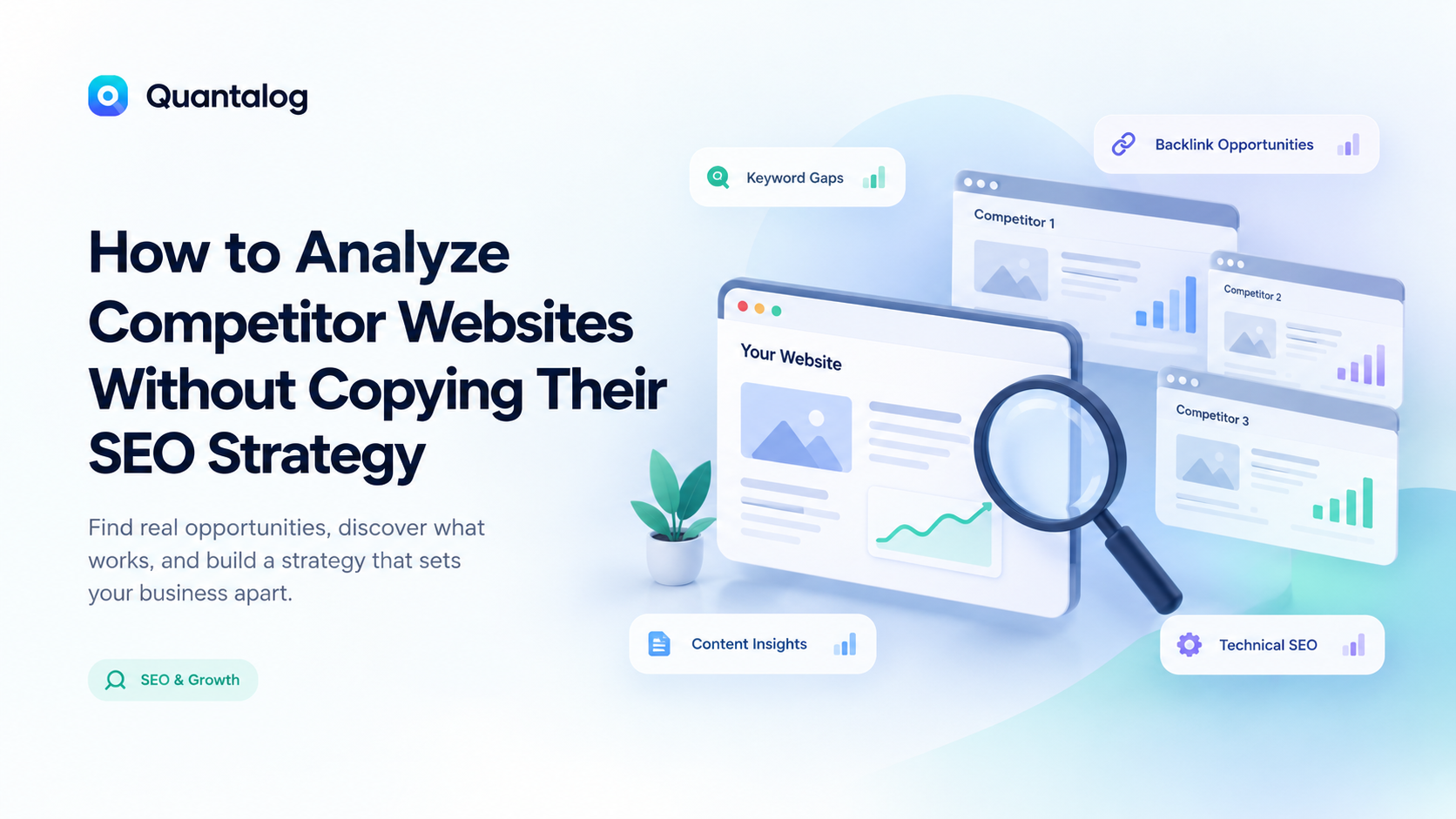
Every business wants to rank higher on Google, attract the right audience, and turn website visitors into customers. But when competitors already appear on the first page of search results, figuring out where to start can be challenging.
This is where competitor website analysis becomes valuable.
By studying competing websites, you can understand which topics they cover, what search queries they target, how their pages are structured, and where opportunities exist in your own strategy.
However, there is an important distinction: learning from competitors is smart SEO; copying their strategy blindly is not.
Your competitors have different audiences, products, resources, and business goals. What works for them might not work for you.
In this guide, we will explore how to analyze competitor websites step by step, uncover actionable SEO opportunities, and build a strategy that fits your business.
1. What Is Competitor Website Analysis?
Competitor website analysis is the process of examining other websites in your market to understand their search visibility, content strategy, website structure, and approach to attracting organic traffic.
The objective is not simply to find out what your competitors are doing. It is to identify what you can learn from their performance and where your website can offer something better or different.
A useful competitor analysis can help you:
Discover relevant keywords you have not targeted.
Identify content topics your audience wants to learn about.
Understand which types of pages perform well in your industry.
Find relevant websites that may be potential backlink sources.
Identify usability and technical SEO improvements.
Discover opportunities to differentiate your product or content.
Think of competitor analysis as research that informs your decisions, not a template you need to reproduce.
2. Identify Your Real SEO Competitors
Your business competitors and SEO competitors are not always the same.
A company might compete with you commercially but receive little organic traffic for the keywords you want to target. Meanwhile, a blog, comparison website, or educational resource might consistently outrank you for those searches.
Start by identifying websites that compete with you in search results.
How to find them
List the main problems your product or service solves.
Search Google using the queries your potential customers would enter.
Review the websites that repeatedly appear in relevant results.
Separate direct business competitors from publishers, directories, and other informational websites.
Select three to five relevant competitors for a focused analysis.
For example, a website analytics platform might compete in search results with analytics products, marketing blogs, software comparison sites, and implementation guides.
These websites can reveal different opportunities. A software competitor may help you understand product positioning, while an educational publisher may reveal content topics worth exploring.
Pro tip: Analyze competitors that attract the audience you want, rather than choosing websites simply because they are popular.
3. Analyze the Keywords Your Competitors Target
Keyword research helps you understand how your competitors attract visitors through organic search.
Look beyond the keywords that describe their products. Explore the questions, problems, comparisons, and practical tasks their audience searches for.
Focus on three types of keywords
Informational keywords: People are looking for answers or instructions.
Examples:
How to track website conversions
How to improve landing page performance
What is event tracking?
Commercial investigation keywords: People are comparing solutions before making a decision.
Examples:
Website analytics tools for SaaS
Product analytics vs website analytics
Best form analytics software
Transactional keywords: People are closer to taking action.
Examples:
Website analytics software
Lead tracking platform
Form analytics tool
The right mix depends on your audience and business model.
How to find keyword gaps
Compare the topics covered by your competitors with the topics already addressed on your website.
Look for relevant searches where competitors have useful pages but your website has no strong answer.
Prioritize opportunities using these questions:
Does this keyword match my product or expertise?
Does it reflect a real problem my audience faces?
Can I create a more useful answer than the existing results?
Does the topic support a meaningful business goal?
A keyword gap is an opportunity only when the topic is relevant to your audience. You do not need to target every keyword a competitor ranks for.
4. Study Your Competitors' Top-Performing Content
Once you understand their keywords, examine the pages that appear to perform well in search results.
Do not focus only on blog posts. Product pages, comparison pages, tutorials, resource hubs, and case studies may all attract valuable organic traffic.
For each page, evaluate:
Search intent: What question or need does the page address?
Content depth: Does it explain the topic thoroughly?
Structure: Are headings, examples, and sections easy to follow?
Originality: Does it include original research, practical experience, or useful examples?
Internal links: Does it connect readers to relevant resources?
Next step: Does it help readers move toward a relevant action?
Turn observations into better content
Suppose a competitor publishes an article explaining website conversion tracking.
Rather than rewriting the same article, investigate what the reader might still need. Perhaps the existing results lack implementation examples, troubleshooting steps, or a clear explanation of how to measure form submissions.
You could create a guide that fills those gaps with original examples, accurate instructions, and a clearer structure.
The goal is to improve the usefulness of the information, not simply to make your article longer.
5. Examine Their Website Structure and Internal Linking
A website's structure affects how users navigate its content and how search engines discover relationships between pages.
Look at how competitors organize their websites.
What to examine
Navigation: Can visitors easily find products, resources, documentation, and support?
Topic clusters: Do they group related articles around broader subjects?
Internal links: Do educational articles connect to relevant product pages and supporting guides?
URL structure: Are page URLs descriptive and logically organized?
Important pages: Which pages receive prominent links from navigation, resource hubs, or related content?
Use these observations to improve your own information architecture.
For example, if your website publishes several articles about conversion measurement, you could connect them through a central guide and link to relevant tutorials. This helps readers explore related topics without having to search for each article separately.
Avoid copying another website's navigation or URL patterns simply because they look successful. Build a structure that makes sense for your content and users.
6. Investigate Competitor Backlinks
Backlinks are links from other websites pointing to a page on your website. They can help search engines discover pages and may contribute to search rankings.
Competitor backlink analysis helps you discover how other websites earn links and identify legitimate opportunities for your own content.
What to look for
Industry publications that reference useful resources.
Relevant blogs that cite original research.
Directories that serve your specific industry.
Partner pages and genuine business relationships.
Articles that link to helpful tools, templates, or guides.
For example, if several relevant websites reference a competitor's original research report, that suggests an opportunity to create your own valuable research or data resource.
You could then reach out to publishers who would genuinely benefit from citing it.
However, a competitor's backlink profile is not a list of links you should automatically replicate. Some links may be irrelevant, outdated, or obtained through practices that are not worth following.
Prioritize relevance and editorial value over the raw number of backlinks.
7. Review Technical SEO and User Experience
Competitor analysis is not limited to keywords and content. Technical performance and usability also influence how effectively a website serves its audience.
Review publicly observable elements of competitor websites and compare them with your own.
Technical SEO checklist
Are important pages accessible and indexable?
Are page titles and meta descriptions clear and relevant?
Does the website work well on mobile devices?
Do important pages load reliably?
Is the navigation easy to use?
Are there broken links or confusing URL patterns?
Is structured data used appropriately where relevant?
Tools such as Google PageSpeed Insights, Google Search Console, and browser developer tools can help you investigate your own website and validate potential improvements.
Be careful when drawing conclusions from competitor websites. You generally cannot know their complete analytics data, indexing configuration, or conversion performance from the outside.
Use observable evidence to generate hypotheses, then validate those hypotheses on your own website.
8. Turn Competitor Insights Into Your Own SEO Strategy
Research is useful only when it leads to better decisions.
After analyzing your competitors, organize your findings into a simple action plan.
Observation | Possible opportunity | Your next action |
|---|---|---|
Competitors cover a relevant topic you have not addressed | Content gap | Publish an original, useful guide |
Their article lacks practical examples | Content quality gap | Add real workflows, examples, and troubleshooting |
Several relevant sites reference the same type of resource | Link opportunity | Create a stronger original resource |
Your important pages are difficult to navigate | Usability issue | Improve navigation and internal links |
Your pages target the wrong search intent | Relevance issue | Align content with the user's actual question |
Prioritize opportunities intelligently
You do not need to implement every observation at once.
Score each opportunity against three factors:
Relevance: How closely does it match your audience and product?
Potential impact: Could it improve qualified traffic, conversions, or user experience?
Effort: How much time and development work will it require?
Start with opportunities that are highly relevant, potentially valuable, and achievable with your current resources.
Also, measure the results after making changes. Track relevant organic queries, impressions, clicks, engagement, and conversions where applicable. This helps you determine whether your strategy is producing meaningful improvements.
9. Common Competitor Analysis Mistakes to Avoid
Even thorough research can lead to poor decisions if the findings are interpreted incorrectly.
Copying content instead of identifying gaps
Reproducing a competitor's articles, wording, or page layouts does not create a distinctive reason for users to visit your website. Build content around your own expertise and audience needs.
Chasing every competitor keyword
Some keywords attract visitors who are unlikely to need your product. Focus on relevant search intent rather than traffic volume alone.
Treating competitor rankings as proof of success
A page ranking well does not automatically mean it generates qualified leads or business revenue. You usually cannot see a competitor's private conversion data.
Focusing only on backlinks
Links are one part of SEO. Useful content, technical accessibility, search intent, and user experience deserve attention too.
Ignoring your own performance data
Competitor research shows what others are doing. Your own analytics and search performance help you understand what works for your audience.
Making too many changes at once
If you change titles, content, internal links, and page structure simultaneously, it becomes harder to understand which changes influenced the results. Where practical, prioritize and document your changes.
10. Build a Repeatable Competitor Analysis Process
Competitor analysis should not be a one-time exercise. Search results, customer needs, and competitors' websites change over time.
A repeatable process makes it easier to turn research into consistent improvements.
Monthly or quarterly workflow:
Review the main competitors appearing for your priority searches.
Identify new topics, keywords, and pages worth investigating.
Compare their content with your existing pages.
Identify technical, content, or internal-linking opportunities.
Choose a small number of high-priority actions.
Measure the results and update your plan.
Keep a simple record of what you observed, what you changed, and what happened afterward. Over time, this creates a more reliable basis for SEO decisions than reacting to every competitor update.
Analyzing competitor websites is one of the most useful ways to discover SEO opportunities, but the real value comes from how you apply the findings.
Study the keywords they target, understand their content, investigate relevant backlinks, and evaluate their website structure. Then compare those observations with your audience's needs and your own website's performance.
You do not need to outrank competitors by doing exactly what they do. You need to provide a more relevant, useful, and distinctive experience for the people you want to reach.
Use competitor analysis to discover the opportunity. Use your own data and expertise to decide what to do next.
Measure What Matters With Quantalog
A competitor's website can show you what is publicly visible, but your own website data helps you understand how visitors interact with your pages.
With Quantalog, you can explore website analytics and use performance insights to guide your next steps. You can also explore Quantalog Search Visibility for more on understanding your website's search presence.
Start with the questions your audience cares about, build a strategy around those needs, and measure the progress that matters to your business.