Your Website Got 10,000 Visitors. So Why Did Nobody Buy?
Getting thousands of website visitors but no customers? Learn why traffic doesn't always lead to sales and how to identify where visitors drop off.

Quantalog
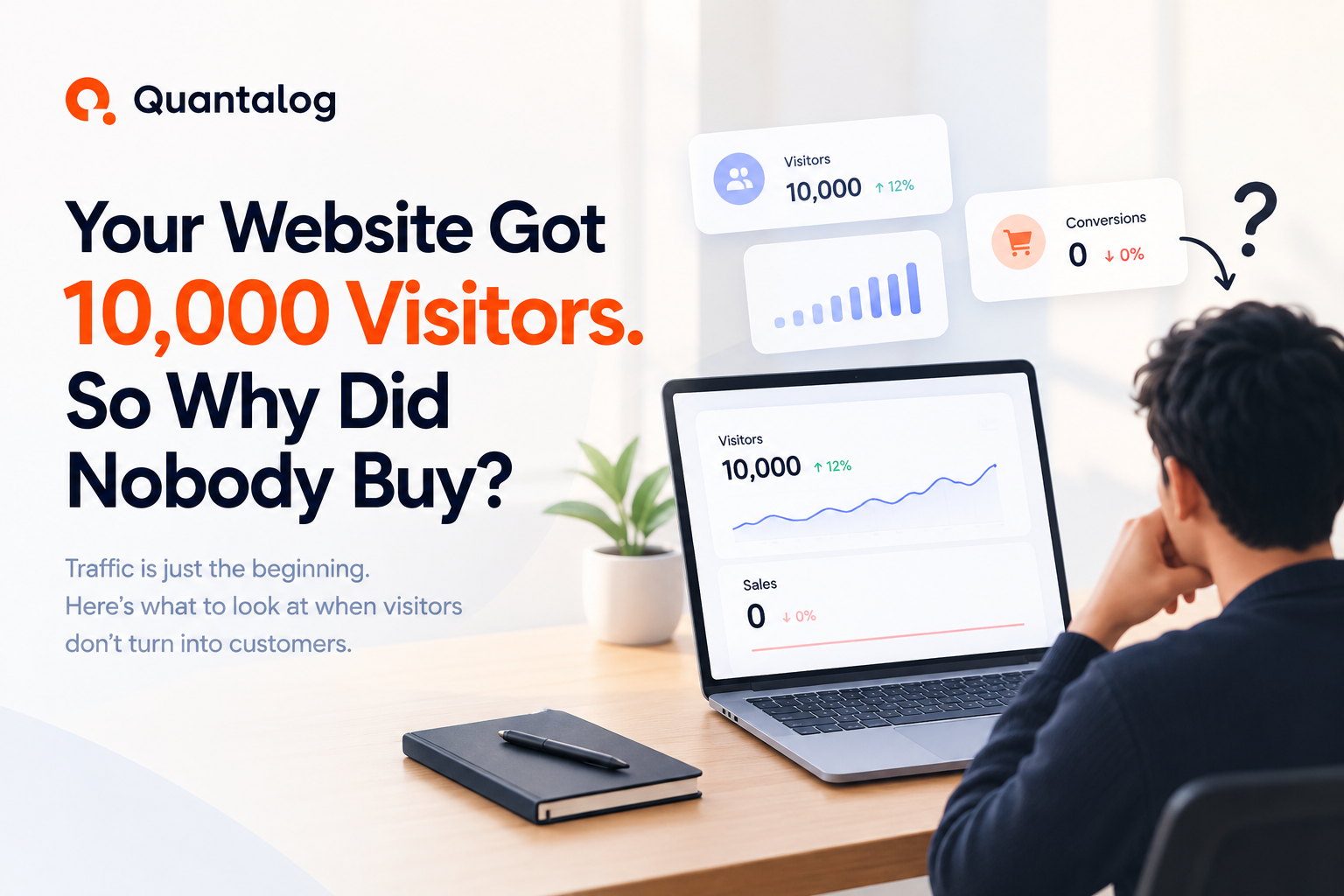
10,000 visitors sounds like a success.
The traffic graph is going up. Your marketing campaign is generating clicks. Your analytics dashboard looks healthy.
Then you check your sales.
0 customers.
Maybe there were a few signups. Maybe someone submitted a contact form. But compared with 10,000 visitors, the result feels surprisingly small.
So what went wrong?
The problem may not be that your website needs more traffic.
It may be that the traffic you're getting, the pages you're sending people to, and the experience they have after arriving aren't aligned with what you want them to do.
Traffic is not the same as demand
A visitor is simply someone who arrived at your website.
It doesn't necessarily mean they are interested in buying.
Consider two websites.
Website A receives 10,000 visitors from a broad social media campaign.
Website B receives 1,000 visitors from people actively searching for the exact problem its product solves.
Website A has ten times the traffic.
But traffic volume alone doesn't tell you which audience has stronger purchase intent.
This is one of the easiest mistakes to make when reading analytics:
assuming more visitors automatically means more customers.
They don't.
Traffic is an opportunity. Conversion depends on what happens next.
Start with one question: Who are these visitors?
Before looking at buttons, colors, headlines, or pricing, look at your acquisition sources.
Your 10,000 visitors might actually look something like this:
Source | Visitors | Leads |
|---|---|---|
4,200 | 96 | |
Social | 3,100 | 18 |
Direct | 1,700 | 21 |
Referral | 700 | 12 |
Other | 300 | 3 |
Suddenly, the 10,000 visitors don't look like one audience anymore.
They're several different audiences arriving for different reasons.
Some may be looking for information.
Some may be researching a problem.
Some may already know your brand.
Others may have clicked a post simply because the headline caught their attention.
Treating all of them as the same type of visitor makes it difficult to understand why conversions are low.
The landing page may be attracting the wrong expectation
Imagine you run an analytics product and publish an article called:
"How to Track Website Visitors."
The article gets thousands of visits.
That's great.
But if the majority of those visitors are looking for a quick explanation rather than an analytics platform, sending every one of them directly to a pricing page probably won't produce many customers.
The problem isn't necessarily the article.
The article may be doing exactly what it was designed to do: answer a question.
The important thing is understanding what visitors expect when they arrive and whether the next step makes sense for them.
Good conversion journeys don't force every visitor toward the same action.
They give people a relevant next step.
Then look at what happens after the first page
This is where analytics becomes particularly useful.
A visitor lands on your website.
What happens next?
Maybe they:
Landing page → Product page → Pricing → Signup
That's a very different journey from:
Landing page → Exit
And it's different again from:
Landing page → Blog → Blog → Blog → Exit
The first journey suggests a visitor is exploring the product.
The second tells you they didn't continue.
The third may indicate that your content is attracting attention, but the visitor isn't naturally moving toward your product.
None of these journeys automatically tells you why someone behaved that way.
But they give you places to investigate.
Find the page where interest disappears
Suppose your funnel looks like this:
10,000 visitors
↓
3,200 visit a product page
↓
850 view pricing
↓
120 start signup
↓
0 complete payment
That's a very different problem from having 10,000 visitors and only 20 reaching your product page.
In the first case, people are reaching the product and showing enough interest to begin signing up. The biggest issue may be somewhere around the signup or payment experience.
In the second case, the problem could be much earlier in the journey.
This is why simply looking at total visitors isn't enough.
You need to know where the journey changes.
Your most popular page may not be your most valuable page
A blog post can receive 20,000 views and generate very little business.
A pricing page might receive only 800 views but contribute to a large percentage of your conversions.
That doesn't make the blog post useless.
It means the two pages serve different purposes.
One may create awareness.
The other may support a purchase decision.
Analytics becomes much more useful when you stop asking only:
"Which page gets the most traffic?"
and start asking:
"Which pages contribute to the outcome I'm trying to create?"
Sometimes the problem is the message
A visitor should be able to understand relatively quickly:
What is this?
Who is it for?
Why should I care?
What should I do next?
If the answers aren't clear, visitors may leave even when the product itself is good.
For example, imagine an analytics product with a homepage headline that says:
"Advanced Data Infrastructure for the Modern Web."
It sounds impressive.
But a small business owner might still wonder:
"Okay, but what does this actually do for me?"
Compare that with a message that clearly explains the product's purpose.
The goal isn't to make the headline clever.
It's to reduce the amount of work a visitor has to do to understand the value.
More visitors won't fix a confusing website
When conversion is low, the natural reaction is often:
"We need more traffic."
So the marketing budget increases.
The campaigns expand.
The traffic graph climbs.
But if the underlying conversion problem hasn't changed, you're simply sending more people into the same experience.
That's why understanding the existing traffic is important before trying to scale it.
If 10,000 visitors aren't converting, investigate the 10,000 you already have.
You may learn more from their behavior than from another 10,000 visitors.
Look at the complete journey
A useful analytics setup should help connect the different pieces of a visitor's journey.
For example:
Traffic source
→ Landing page
→ Pages viewed
→ Product interaction
→ Pricing
→ Lead/signup
→ Customer
You don't need to assume what every visitor is thinking.
You need enough data to identify patterns.
Maybe visitors from one campaign consistently reach pricing but rarely start signup.
Maybe visitors from another source spend more time reading content but rarely visit the product page.
Maybe one landing page generates twice as many leads despite receiving half the traffic.
These patterns give you something concrete to investigate.
Ask better questions about your traffic
Instead of asking:
"How can we get more visitors?"
start with questions like:
Where are our visitors coming from?
Which sources generate meaningful engagement?
Which pages do visitors see before converting?
Where do visitors commonly leave?
Which landing pages generate leads?
Are visitors reaching the pages we want them to reach?
Which campaigns generate customers rather than just clicks?
The answers can completely change how you approach growth.
The goal isn't 10,000 visitors
10,000 visitors sounds impressive because it's an easy number to understand.
But a business doesn't grow because a number on an analytics dashboard gets bigger.
It grows when the right people discover the right product and take meaningful actions.
That could be a signup.
A lead.
A demo request.
A purchase.
The exact conversion depends on the business.
The principle is the same:
Traffic is only the beginning of the journey.
What should you measure?
For most websites, a useful starting point is to connect four areas:
Acquisition
Where are visitors coming from?
Engagement
What do they do after arriving?
Intent
Do they reach important pages such as products, pricing, or contact pages?
Conversion
Do they complete the action that matters to your business?
Looking at these together gives you a much clearer picture than visitor counts alone.
So, why did nobody buy?
There isn't always one answer.
Maybe the visitors weren't the right audience.
Maybe your content attracted people who only wanted information.
Maybe the landing page didn't match the campaign that brought them there.
Maybe the value proposition wasn't clear.
Maybe visitors were interested but encountered friction during signup or checkout.
Or maybe you simply haven't connected your traffic data with your conversion data closely enough to see the pattern.
The important thing is not to guess.
Follow the journey.
Your analytics should help you move from:
"We had 10,000 visitors."
to:
"Here's where they came from, what they did, where they dropped off, and which journeys produced leads."
That's the difference between measuring traffic and understanding it.
And once you understand the journey, you can start improving the parts of the website that actually matter.
Try Quantalog on your own site
One script tag, no cookies, live numbers in about three seconds. Free forever on the Hobby plan.
Start freeKeep reading
Why Did This Visitor Leave After 3 Seconds?
A visitor lands on your website and leaves within seconds. Learn what a short session can tell you, what it cannot, and how to investigate the real cause.
A Visitor Came From ChatGPT. Then This Happened.
A visitor clicked your website from ChatGPT. What happens next? Learn how ChatGPT referral traffic works, what analytics can reveal, and why AI traffic matters.