Your Pages Are Indexed but Still Getting No Traffic — Here's Why
Your page is indexed by Google but still gets little or no organic traffic? Learn why indexing doesn't guarantee visibility, rankings, clicks, or visitors—and how to identify what is holding your pages back.
Quantalog
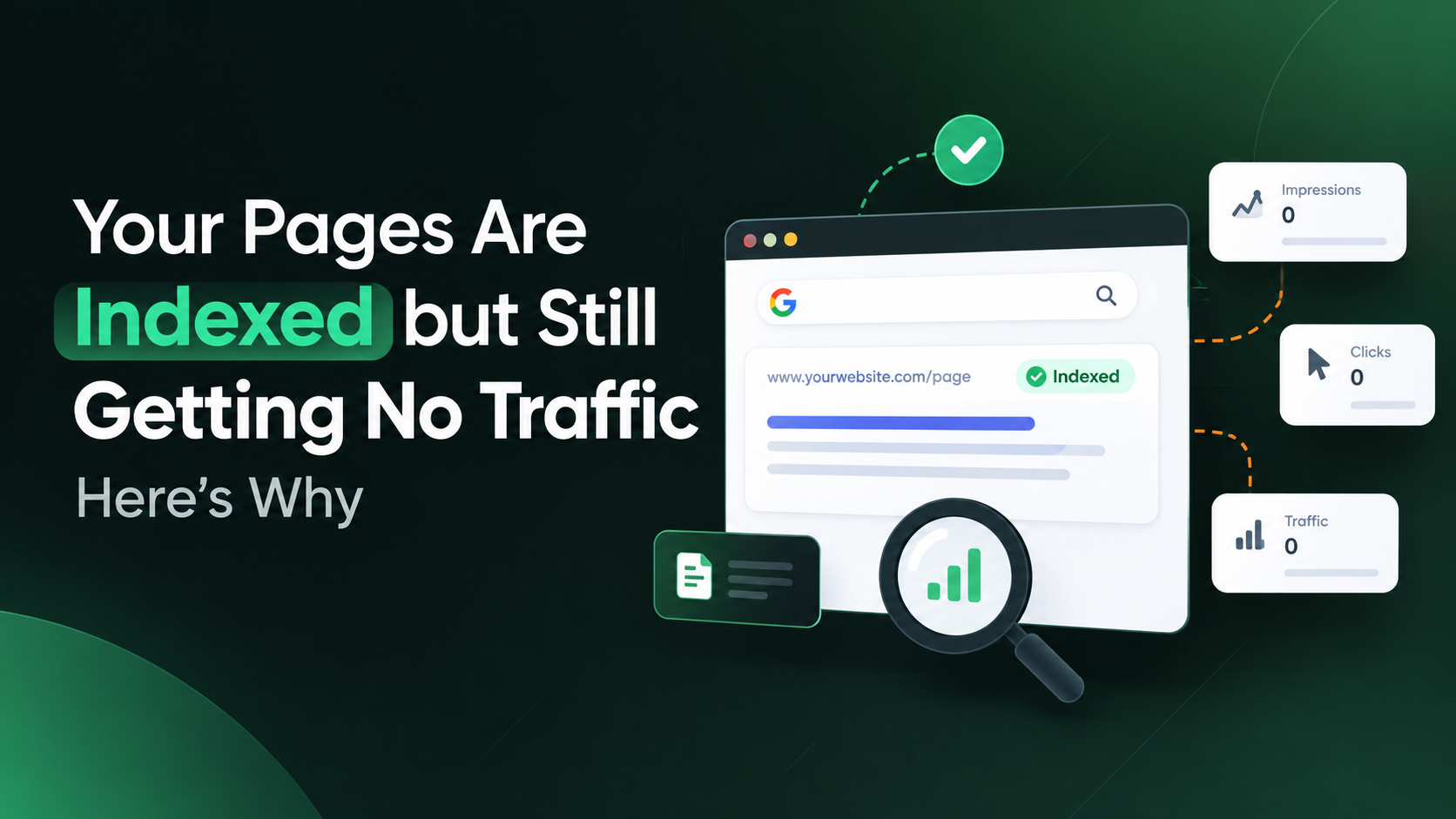
Getting a page indexed by Google feels like the first major SEO milestone.
You publish a page, Google discovers it, the URL appears as indexed in Search Console, and you expect visitors to start arriving.
But sometimes, nothing happens.
The page is indexed. It can technically appear in Google. Yet it receives little or no organic traffic.
This is more common than many website owners realize.
The important thing to understand is that indexing is only one step in the search journey. Being indexed does not automatically mean that Google will rank your page prominently, show it for valuable searches, or generate clicks.
Here's what could be happening.
1. Indexed Doesn't Mean Ranked
The biggest misconception is treating indexing and ranking as the same thing.
They aren't.
When Google indexes a page, it means Google has processed and stored the page in its search index. It does not mean that the page will appear near the top of search results.
For example, imagine you publish a page targeting:
"best analytics tools for small businesses"
Google may index that page successfully.
But if the page is currently ranking around position 60, it is unlikely to receive meaningful organic traffic.
So the first question shouldn't simply be:
"Is my page indexed?"
It should be:
"Where is my page actually appearing for relevant searches?"
2. Your Page May Be Ranking for the Wrong Queries
A page can rank in Google and still receive almost no useful traffic.
Why?
Because it may be appearing for searches that don't match what you intended to target.
Suppose you created an article about:
"Website SEO analytics tools"
You might expect searches around SEO analytics, website analysis, and SEO reporting.
Instead, Google could associate the page with less relevant or extremely low-volume queries.
The page technically ranks, but those rankings don't translate into meaningful clicks.
This is why looking only at your average position isn't enough.
You need to understand:
Which queries are generating impressions
Which queries are generating clicks
What position the page has for those queries
Whether those queries match the page's actual purpose
3. You're Ranking Too Low to Get Clicks
Search position has a major impact on visibility.
A page sitting near the top of the results has a very different opportunity to receive clicks than one buried several pages deep.
For example:
Position | What it generally means |
|---|---|
1–3 | Highly visible |
4–10 | First-page visibility |
11–20 | Potential "striking distance" opportunity |
20+ | Usually requires significant improvement |
These aren't guarantees of traffic. Actual clicks depend on search intent, SERP features, competition, brand recognition, and other factors.
But the general principle is simple:
A page cannot generate much search traffic if it rarely gets seen.
If your indexed page is consistently ranking beyond the first page, improving its relevance, content quality, internal linking, authority, and search intent alignment may be more important than simply publishing another article.
4. There May Not Be Enough Search Demand
Sometimes the problem isn't your SEO.
There simply may not be enough people searching for the topic.
Imagine you publish an extremely detailed article targeting a very specific phrase.
Google indexes it.
Your content is well written.
Your technical SEO is fine.
But only a handful of people search for that topic each month.
Even a strong ranking may produce very little traffic.
This is why keyword research should consider more than competition.
Before investing heavily in a topic, consider:
Search demand
Search intent
Related queries
Audience relevance
Business value
Existing search results
Ranking for a keyword nobody searches for isn't a meaningful SEO win.
5. Your Title Isn't Winning the Click
Let's say your page receives thousands of impressions but only a handful of clicks.
That's a different problem.
It suggests that Google is showing your page, but searchers aren't choosing it often enough.
One metric worth investigating here is click-through rate (CTR).
For example:
1,000 impressions + 20 clicks = 2% CTR
Your page may already have visibility, but something about the search result may not be compelling enough.
Your title and description should clearly communicate what the searcher will get from the page.
Compare:
SEO Analytics
with:
SEO Analytics: 12 Metrics You Should Track in 2026
The second title gives a clearer indication of the page's purpose and potential value.
However, avoid writing misleading titles simply to increase clicks. The page should deliver what the search result promises.
6. Search Intent Doesn't Match Your Content
This is one of the most important reasons an indexed page can struggle.
Someone searches:
"how to check website traffic"
They probably want instructions.
But imagine the top results are dominated by step-by-step guides while your page is primarily a product landing page.
Your page might be technically optimized and even indexed correctly, but it doesn't satisfy the intent behind the search.
Google's search results are heavily influenced by what it believes users are trying to accomplish.
Before trying to improve rankings, ask:
What does someone actually want when they search this query?
Common search intents include:
Informational — learning something
Navigational — finding a specific website or resource
Commercial investigation — comparing solutions
Transactional — taking an action or making a purchase
Your content should match the intent behind the searches you're targeting.
7. Your Page Is Competing Against Much Stronger Results
Sometimes your page is relevant, useful, and well optimized—but the search results are extremely competitive.
You may be competing against:
Established websites
Highly authoritative domains
Long-standing content
Strong backlink profiles
Well-known brands
Pages with extensive topical coverage
In that situation, simply adding more keywords to your page won't necessarily solve the problem.
You may need to build stronger topical authority, improve the depth of the content, strengthen internal linking, earn relevant backlinks, or target more specific search queries.
Instead of immediately targeting the broadest keyword, consider finding lower-competition, highly relevant variations where your site has a realistic opportunity to gain visibility.
8. Your Page May Need Better Internal Links
Internal linking is often overlooked.
Imagine Google discovers your new article through your sitemap, but almost none of your other pages link to it.
Now compare that with a page that is linked from several relevant, authoritative pages across your website.
A strong internal linking structure can help search engines discover relationships between your content and understand which pages are important within your site.
When publishing a new page, look for older relevant articles where you can naturally add links to it.
Don't add links simply for the sake of adding them.
The link should genuinely help the reader move to a related resource.
9. The Page May Have Technical or Content-Quality Problems
Indexing tells you that Google has included the page in its index.
It doesn't mean everything about the page is perfect.
Check for issues such as:
Slow page performance
Poor mobile experience
Duplicate or thin content
Incorrect canonical tags
Weak internal linking
Poor heading structure
Missing or confusing metadata
Content that is outdated
Pages blocked from important resources
Unclear page purpose
Technical SEO isn't always the reason a page receives no traffic, but it is worth checking before assuming the problem is purely about rankings.
10. Your Page May Be New
Don't forget the simplest explanation.
If you published the page yesterday, you may simply need to wait.
Search visibility doesn't always change immediately after publication.
Google needs to discover, crawl, process, and evaluate new content, and rankings can change as the page gains search data and competes with existing results.
Instead of checking the page repeatedly every few hours, monitor its performance over time.
Look for changes in:
Impressions
Queries
Average position
Clicks
CTR
Indexed status
The trend is often more useful than a single day's numbers.
So, What Should You Check First?
If a page is indexed but isn't generating traffic, don't immediately rewrite the entire article.
Start with the data.
A simple diagnostic process is:
Step 1: Check indexing
Confirm that Google has indexed the URL.
Step 2: Check impressions
If impressions are close to zero, the problem is likely visibility, search demand, relevance, or ranking.
Step 3: Check queries
Find out which searches are actually generating impressions.
Step 4: Check average position
Identify whether the page is appearing on the first page or much further down.
Step 5: Check CTR
If impressions are high but clicks are low, investigate the search result's title, description, intent match, and SERP competition.
Step 6: Compare pages
Look at other pages on your site that successfully generate organic traffic.
What do they have in common?
They may target stronger search demand, match search intent better, have more internal links, or have built more authority over time.
The Important Difference Between Indexed, Visible, and Valuable
Think about organic search as a funnel:
Indexed → Ranking → Visible → Clicked → Visited → Engaged → Converted
Each stage represents a different problem.
A page can be:
Indexed but not ranking.
It can be:
Ranking but barely visible.
It can be:
Visible but rarely clicked.
It can be:
Clicked but poorly engaging visitors.
And it can even be:
Generating traffic without generating business results.
That's why looking at one SEO metric rarely tells the complete story.
Don't Confuse Indexing With SEO Success
An indexed page is not a failed page simply because it isn't receiving traffic yet.
It is a starting point.
The real question is what happens after indexing.
Does Google understand the page?
Does it associate the page with relevant queries?
Is there enough search demand?
Is the page ranking competitively?
Are people clicking when they see it?
And once they arrive, are they actually finding what they expected?
Answering those questions gives you a much clearer picture of your website's search visibility.
Final Takeaway
If your page is indexed but getting no traffic, don't assume that Google is ignoring your website.
The issue could be anywhere between search demand and user engagement.
Start by looking at the complete path:
Indexing → Queries → Impressions → Position → CTR → Visits → Engagement
Once you know where the drop-off happens, you can work on the right problem instead of blindly changing keywords or publishing more content.
And that's the real value of monitoring search visibility: you stop guessing and start diagnosing.
For websites growing through organic search, the goal isn't simply to have more indexed pages.
It's to understand which pages are being discovered, how they're appearing in search, what people are searching for, and where opportunities for growth are hiding.
Try Quantalog on your own site
One script tag, no cookies, live numbers in about three seconds. Free forever on the Hobby plan.
Start freeKeep reading
From Google Impression to Customer: Measuring the Full Search Journey
A Google impression is only the beginning of the customer journey. Learn how to connect search impressions, clicks, website visits, engagement, and conversions to understand the real business value of organic search.
Search Clicks vs Website Visitors: Why These Numbers Never Match
Google Search Console clicks and website analytics visitors often show different numbers. Learn why they differ, what each metric actually measures, and how to use both to understand your website's search performance.