How AI Search Is Changing Website Traffic in 2026
AI search is changing how people discover websites, interact with search results, and decide when to click. Learn how AI Overviews, AI Mode, ChatGPT, Gemini, and other AI platforms are reshaping website traffic in 2026 and what website owners should measure now.

Quantalog
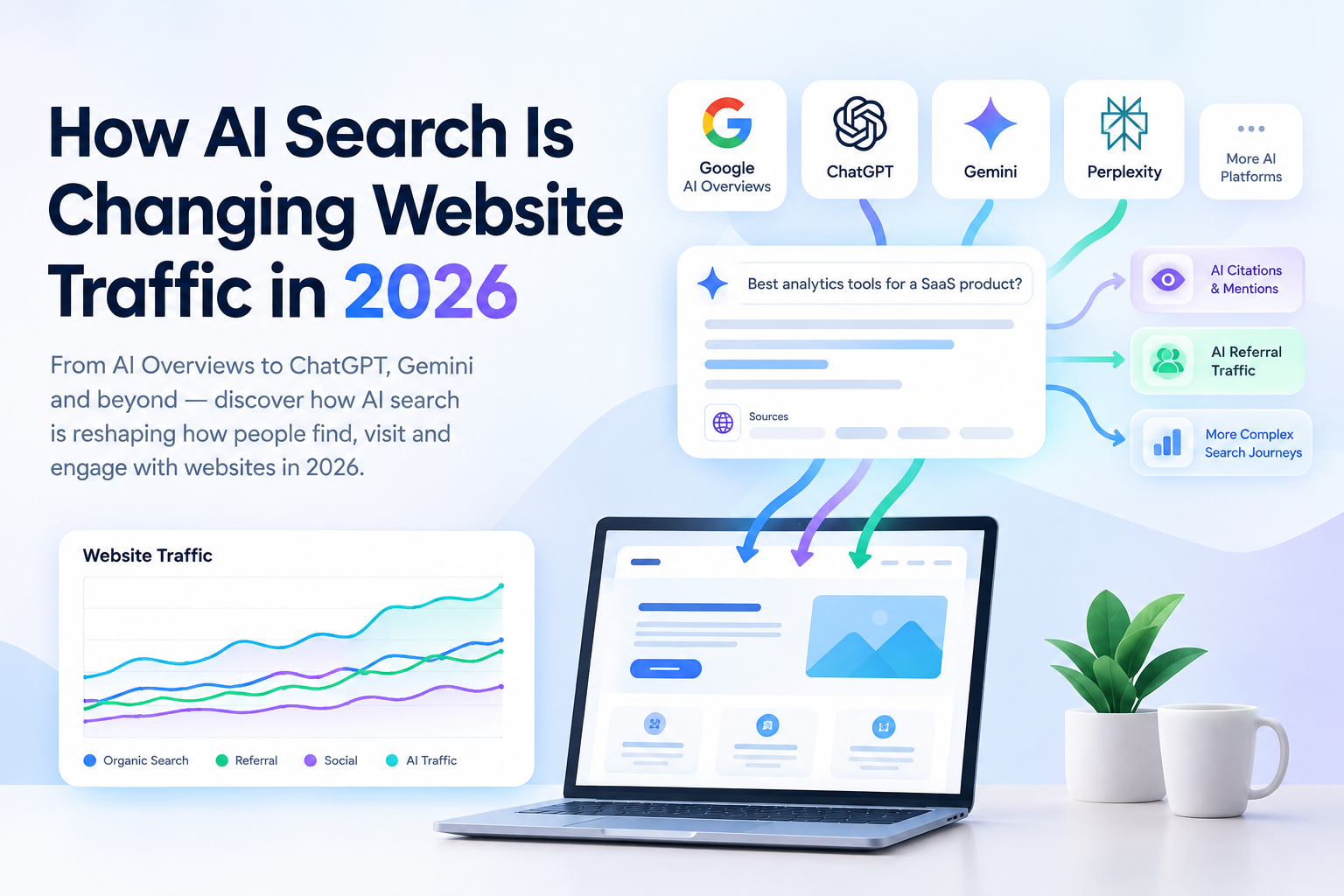
How AI Search Is Changing Website Traffic in 2026
For years, the path from a search query to a website was relatively simple:
Search → Search results → Click → Website
In 2026, that journey is changing.
People can now ask complex questions directly inside AI-powered search experiences, receive synthesized answers, explore follow-up questions, compare options, and sometimes complete much of their research without immediately visiting a website.
Google has expanded AI Overviews and AI Mode, while platforms such as ChatGPT, Gemini, Perplexity, Claude, and Copilot are becoming part of the modern information-discovery journey.
Google says its AI search experiences are generating more searches and new types of queries. As of June 2026, Google reported that AI Overviews had more than 2.5 billion monthly active users and AI Mode had surpassed one billion monthly users.
For website owners, this creates an important shift:
Website traffic is no longer just about ranking in traditional search results. It is increasingly about being discovered, referenced, and selected across AI-driven search journeys.
This guide explains what is changing, why it matters, and how businesses can adapt their analytics and content strategies for 2026.
The Search Journey Is Becoming More Complex
Traditional search generally involved a user entering a query, scanning results, and clicking a website.
AI search introduces additional layers.
A modern journey can look more like this:
User has a question
        ↓
Google / ChatGPT / Gemini / Perplexity
        ↓
AI-generated answer
        ↓
Sources and recommendations
        ↓
Follow-up questions
        ↓
Website visit
        ↓
Product / service / conversion
Sometimes the website visit happens immediately.
Sometimes it happens later.
And sometimes it does not happen at all.
This is one of the biggest changes website owners need to understand.
The value of a website may now begin before the user ever visits the website.
1. AI Search Can Reduce Some Traditional Clicks
One of the biggest concerns surrounding AI search is the growth of zero-click searches.
A zero-click search occurs when a user gets enough information directly from the search experience without clicking through to another website.
This behavior is not completely new. Search engines have provided features such as featured snippets, knowledge panels, weather information, sports scores, calculators, and other direct answers for years.
Generative AI takes this concept considerably further by synthesizing information across more complicated questions.
Recent experimental research has found that the presence of Google AI Overviews can reduce outbound organic clicks in some search scenarios. One 2026 field experiment reported a 39.8% reduction in outbound organic clicks when AI Overviews appeared, alongside a 34.5% increase in zero-click searches.
That does not mean every website will experience a 39.8% traffic decline.
The result comes from a specific experiment and should not be interpreted as a universal website-traffic benchmark.
Instead, it demonstrates a broader trend:
The relationship between search visibility and website clicks is changing.
2. Search Visibility and Website Traffic Are Becoming Two Different Metrics
Historically, many businesses treated rankings as a proxy for visibility.
For example:
Traditional SEO Metric | What It Tells You |
|---|---|
Keyword ranking | Where your page appears |
Impressions | How often your result is shown |
CTR | How often users click |
Organic sessions | How much traffic search generates |
Conversions | What that traffic produces |
AI search adds another layer:
AI Search Metric | What It Can Tell You |
|---|---|
AI visibility | Whether your brand/content appears in AI experiences |
AI citations | Whether AI systems reference your content |
AI referral sessions | Whether AI platforms send visitors |
Engagement | What those visitors do after arriving |
Assisted conversions | Whether AI discovery contributes to conversions |
This distinction matters.
A website could become increasingly visible inside AI-generated answers without seeing the same proportional increase in direct referral traffic.
At the same time, another website may receive relatively small volumes of AI referral traffic but attract highly engaged visitors.
Therefore, traffic volume alone is no longer enough to understand AI search performance.
3. AI Referral Traffic Is Becoming a New Analytics Channel
AI platforms can also send users directly to websites.
For example:
ChatGPT
Gemini
Perplexity
Claude
Microsoft Copilot
Other AI-powered discovery platforms
Semrush's analysis of 17 months of U.S. clickstream data found that outbound referral traffic from ChatGPT to the wider web grew 206% during 2025. The same study found that more than 30% of ChatGPT referral traffic went to just 10 domains.
Another 2026 analysis by SE Ranking found that AI platforms accounted for 0.32% of overall website traffic in its dataset, up from 0.02% in 2024. It also reported that ChatGPT remained the largest source of AI referral traffic in its analysis, followed by Gemini and Perplexity.
These percentages should not be treated as universal benchmarks because different studies use different datasets and methodologies.
But they point toward an important development:
AI referral traffic is becoming measurable enough to deserve its own analytics category.
4. AI Traffic and Traditional Organic Traffic Behave Differently
A visitor arriving through Google Search and a visitor arriving through an AI assistant may have very different journeys.
Consider these two examples.
Traditional search journey
"best analytics tools for SaaS"
        ↓
Google
        ↓
10 blue links / search features
        ↓
User compares multiple websites
        ↓
Website visit
        ↓
Research
        ↓
Possible conversion
AI-assisted journey
"I need a privacy-friendly analytics tool
for my SaaS product with real-time reporting."
        ↓
AI assistant
        ↓
Personalized recommendation
        ↓
User evaluates cited/recommended options
        ↓
Website visit
        ↓
Product evaluation
        ↓
Possible conversion
The second visitor may arrive with considerably more context.
This is why website owners should measure not just how much AI traffic they receive, but also what those visitors do after arriving.
5. AI Search Is Also Changing the Type of Questions People Ask
Traditional search often encouraged short keyword queries.
For example:
"best analytics software"
AI interfaces make longer, conversational questions natural:
"What analytics platform should I use for a SaaS product if I want real-time analytics without relying heavily on cookies?"
This creates new opportunities for content creators.
Instead of optimizing only for short keywords, businesses need to understand:
Questions users actually ask
Problems they are trying to solve
Comparisons they make
Follow-up questions
Product-specific requirements
Industry-specific use cases
Purchase considerations
Google's current guidance emphasizes that existing SEO fundamentals remain relevant for AI features and recommends creating valuable, unique content rather than relying on special tricks to appear in AI results.
6. SEO Is Not Dead — It Is Becoming Part of a Larger Search Strategy
The rise of AI search does not mean traditional SEO has stopped mattering.
In fact, Google explicitly says that its established SEO best practices remain relevant for AI features such as AI Overviews and AI Mode.
A modern search strategy can therefore be viewed as:
                 SEARCH VISIBILITY
                        │
          ┌─────────────┴─────────────┐
          │                           │
       Traditional                 AI Search
          │                           │
       Google SEO                 GEO / AI Visibility
          │                           │
   Organic rankings             AI citations
   Search impressions            AI mentions
   Search clicks                AI referrals
          │                           │
          └─────────────┬─────────────┘
                        │
                  Website Traffic
                        │
                    Engagement
                        │
                    Conversion
The goal is not to replace SEO.
The goal is to expand your definition of search visibility.
7. Google Is Already Adding AI-Specific Search Reporting
This shift is becoming visible in analytics products themselves.
In June 2026, Google announced new Search Console reporting for generative AI features. The reporting provides dedicated insights into visibility within AI experiences such as AI Overviews and AI Mode, alongside broader Search and Discover reporting. Google subsequently stated that these insights had rolled out to websites worldwide by August 31, 2026.
That is an important signal for website owners.
Search analytics is moving beyond:
"Did I rank?"
toward questions such as:
"How am I being discovered inside AI-powered search?"
8. The New Website Traffic Funnel
The traditional acquisition funnel needs to evolve.
Traditional model
Search
  ↓
Impression
  ↓
Click
  ↓
Website
  ↓
Engagement
  ↓
Conversion
AI-era model
User question
      ↓
AI discovery
      ↓
Brand/content visibility
      ↓
Citation / recommendation
      ↓
AI referral
      ↓
Website visit
      ↓
Engagement
      ↓
Conversion
There can also be another path:
AI discovery
      ↓
No immediate click
      ↓
User remembers brand
      ↓
Direct visit later
      ↓
Conversion
This makes attribution more difficult.
The final direct visit may not tell the complete story of how the user originally discovered the business.
9. What Website Owners Should Start Measuring
If your website depends on search for acquisition, 2026 is a good time to expand your analytics dashboard.
At minimum, consider tracking the following.
Core website metrics
Category | Metrics |
|---|---|
Traffic | Visitors, sessions, pageviews |
Acquisition | Organic, referral, direct, social, AI |
Engagement | Engagement rate, time, pages/session |
Geography | Country, region, city |
Technology | Device, browser, operating system |
Campaigns | UTM source, medium, campaign |
Conversion | Signups, leads, purchases |
AI | AI referrals, AI landing pages, AI-assisted conversions |
The important part is not collecting every possible metric.
The important part is being able to answer:
Where did this visitor come from, what did they do, and did that visit contribute to business results?
10. Build an AI Referral Dashboard
A simple AI traffic dashboard could look like this:
Metric | Example |
|---|---|
AI sessions | 1,284 |
AI visitors | 1,017 |
AI share of total traffic | 3.2% |
AI referral conversion rate | 4.8% |
Top AI source | ChatGPT |
Second source | Gemini |
Top AI landing page | /pricing |
AI-assisted conversions | 73 |
You can then break AI traffic down by source:
AI Platform | Sessions | Engagement | Conversions |
|---|---|---|---|
ChatGPT | 620 | 68% | 34 |
Gemini | 286 | 64% | 17 |
Perplexity | 194 | 71% | 14 |
Claude | 91 | 69% | 6 |
Other | 93 | 61% | 2 |
These numbers are illustrative, not industry benchmarks.
The purpose of this reporting is to make AI-driven acquisition visible alongside traditional channels.
11. Content Strategy Needs to Change Too
If AI systems increasingly help users discover information, simply publishing hundreds of generic articles may not be enough.
A stronger strategy is to build content around first-hand expertise, useful explanations, specific questions, and original information.
For example, instead of:
"What is website analytics?"
Create:
"How to Measure AI Search Traffic for a SaaS Website"
Instead of:
"What is SEO?"
Create:
"SEO vs GEO: How Search Visibility Works in 2026"
Instead of:
"Analytics tools"
Create:
"What Should a SaaS Company Track Beyond Pageviews?"
The second type of content has a clearer purpose and can answer more specific user needs.
Google's guidance for generative AI search specifically highlights valuable and unique content and says that traditional SEO fundamentals continue to apply.
12. Original Data Can Become More Valuable
One of the strongest ways to differentiate content is by publishing information that cannot easily be replicated from generic sources.
Examples include:
Original research
Customer benchmarks
Product experiments
Industry surveys
Performance tests
Case studies
Proprietary datasets
First-hand implementation lessons
Screenshots and demonstrations
For example:
"We analyzed 100,000 website sessions to understand how AI referrals behave."
is fundamentally different from:
"AI is becoming important for websites."
The first provides original information.
The second simply repeats an industry trend.
As AI-generated content becomes easier to produce, original information can become a stronger competitive advantage.
13. Don't Optimize Only for AI Citations
It may be tempting to think:
"I just need to get mentioned by ChatGPT or Google AI."
That is too narrow.
A better objective is:
Be discoverable
       ↓
Be useful
       ↓
Be trusted
       ↓
Be referenced
       ↓
Earn the click
       ↓
Create a valuable website experience
       ↓
Convert the visitor
AI visibility without a useful website does not create much business value.
Likewise, large amounts of traffic without meaningful engagement may not produce results.
The real goal should be qualified discovery and measurable business outcomes.
14. What This Means for SaaS Companies
SaaS companies have a particularly interesting opportunity.
Potential customers increasingly use conversational tools to ask questions such as:
Which analytics tool is suitable for a SaaS startup?
How can I track website visitors without cookies?
What is the difference between GA4 and privacy-first analytics?
Which analytics platform supports real-time reporting?
How can I monitor AI search traffic?
What should I track on my SaaS website?
These questions can happen before a visitor ever reaches a company's website.
Therefore, SaaS companies should consider creating content around:
Educational content
Explain concepts clearly.
Comparison content
Help users understand differences between approaches and tools.
Use-case content
Show how a product solves specific problems.
Technical content
Demonstrate implementation and architecture.
Data-driven content
Publish original findings and benchmarks.
Product documentation
Make product capabilities easy for humans and machines to understand.
15. AI Search Does Not Mean You Should Abandon Traditional SEO
This is one of the most important points.
AI search and traditional search are not separate worlds.
They overlap.
Google's own documentation states that there are no additional technical requirements or special optimizations required to appear in AI Overviews or AI Mode. It also says that established SEO best practices remain foundational.
That means businesses should continue investing in:
Crawlability
Indexability
Good site architecture
Useful content
Descriptive titles
Internal linking
Structured information
Page experience
Mobile usability
Fast websites
Original expertise
Clear author and business information
The difference is that these foundations now support a broader range of discovery experiences.
16. The Biggest Analytics Mistake to Avoid
The biggest mistake is looking at one number and assuming it tells the entire story.
For example:
"Organic traffic dropped, so our SEO strategy failed."
That conclusion may be too simplistic.
You should investigate:
Organic traffic
      ↓
Did impressions change?
      ↓
Did rankings change?
      ↓
Did AI features appear?
      ↓
Did CTR change?
      ↓
Did AI referrals increase?
      ↓
Did direct traffic change?
      ↓
Did conversions change?
Traffic should be analyzed as a system rather than as a single number.
This is especially important because different studies are finding different effects across websites and datasets.
Google has reported relatively stable overall organic click volume and higher average click quality, while independent research has found substantial click reductions in specific AI-search conditions.
The takeaway is not that one side is universally correct.
The takeaway is that AI search is changing user behavior, and individual websites need their own data to understand the impact.
17. A Practical 2026 AI Search Strategy
Website owners can start with five steps.
Step 1: Establish your baseline
Measure:
Organic sessions
Organic conversions
Direct traffic
Referral traffic
Social traffic
AI referral traffic
Step 2: Identify AI referrals
Create a dedicated channel for traffic arriving from AI platforms.
Step 3: Analyze landing pages
Find which pages AI-referred visitors are landing on.
Step 4: Compare visitor quality
Compare AI visitors with traditional organic visitors.
Look at:
Engagement
Session depth
Conversion rate
Signups
Purchases
Returning visitors
Step 5: Monitor AI visibility
Where available, use search-platform reporting to understand how your content is appearing within generative search experiences.
Google's new Search Console reporting specifically provides visibility insights for generative AI features in Search.
18. What Website Traffic Could Look Like in the AI Era
The future probably won't be:
Google → Website
Instead, expect multiple discovery paths:
                    ┌── Google Search ───────┐
                    │                        │
                    ├── Google AI Search ────┤
                    │                        │
User ───────────────┼── ChatGPT ─────────────┼── Website
                    │                        │
                    ├── Gemini ──────────────┤
                    │                        │
                    ├── Perplexity ──────────┤
                    │                        │
                    └── Social / Communities ┘
                                             ↓
                                         Engagement
                                             ↓
                                         Conversion
This means analytics platforms need to evolve from simply measuring website traffic to understanding digital discovery.
19. The New Definition of Search Visibility
Search visibility used to mean:
"Where does my website rank?"
In 2026, a more complete question is:
"Where does my business appear when potential customers search for solutions?"
That could mean:
A traditional Google result
An AI Overview
Google AI Mode
A ChatGPT response
A Gemini response
A Perplexity answer
A recommendation inside another AI experience
A referral from an AI platform
A later direct visit
This is the fundamental shift website owners need to understand.
Conclusion
AI search is not simply another traffic source.
It is changing the discovery layer of the web.
Users can now ask more complex questions, receive synthesized answers, explore recommendations, and decide whether to visit a website after an AI-assisted research process.
At the same time, AI-generated answers can reduce clicks for some searches, while AI platforms can also send meaningful referral traffic to websites. Current research shows that the effect varies by platform, query type, website, and measurement methodology.
For website owners, the response should not be to abandon SEO.
Instead, the strategy should expand:
SEO + AI visibility + AI referral tracking + engagement analytics + conversion measurement.
The websites that adapt well will not simply ask:
"How much traffic did Google send us?"
They will ask:
"How are people discovering us across the new search ecosystem, and what happens after they find us?"
That is the analytics question that matters in 2026.
Frequently Asked Questions
Is AI search replacing Google Search?
Not entirely. Google remains a major search platform, while AI-powered features are being integrated directly into Google Search. Other AI platforms are also becoming part of users' discovery journeys. The available evidence suggests that search behavior is becoming more diverse rather than simply moving from one platform to another.
Does AI search reduce website traffic?
It can reduce clicks for some types of searches, particularly when users receive enough information directly in an AI-generated answer. However, AI platforms can also send referral traffic to websites. The effect varies significantly by query, platform, industry, and website.
Is SEO still important in 2026?
Yes. Google states that established SEO fundamentals remain relevant for AI Overviews and AI Mode. There is no separate technical requirement that guarantees inclusion in AI search features.
What is AI referral traffic?
AI referral traffic is website traffic that arrives after a user interacts with an AI platform such as ChatGPT, Gemini, Perplexity, Claude, or another AI-powered service and then visits a website.
Should businesses track AI traffic separately?
Yes. Separating AI referrals from traditional referral, organic, social, and direct traffic can help businesses understand how AI platforms contribute to discovery, engagement, and conversions.
What should websites optimize for AI search?
Start with the fundamentals: useful original content, strong technical SEO, clear website structure, crawlability, authoritative information, and content that directly answers users' questions. Google specifically recommends continuing established SEO best practices for AI search.
Try Quantalog on your own site
One script tag, no cookies, live numbers in about three seconds. Free forever on the Hobby plan.
Start freeKeep reading
Does AI search send traffic? How to measure it
ChatGPT, Perplexity and Gemini referrals hide inside Direct and unclassified referrers. How to isolate the channel, why it undercounts, and what makes a page quotable.
The Internet Is Getting More AI Traffic Than Ever — Can Analytics Still Tell Humans and Bots Apart?
AI crawlers, bots, and autonomous agents are changing website traffic. Learn how AI traffic affects analytics and how to distinguish humans, bots, and AI agents.